Kermes: Difference between revisions
m (Text replace - "== Authority ==" to "== Sources Checked for Data in Record ==") |
|||
| (10 intermediate revisions by 2 users not shown) | |||
| Line 1: | Line 1: | ||
== Description == | == Description == | ||
A natural red dye obtained from the dried bodies of the female insects, ''Kermes vermilio'' Planchon and ''Kermes ilicis'' (formerly ''Coccus ilicis''), found in southern Europe on the small evergreen kermes oak, ''Quercus coccifera''. Kermes dye, used since ancient times, has about one-tenth the coloring power of cochineal. The primary colorant, [[kermesic acid]], is extracted by water. Kermes also contains 18-32% tannins and is used for making a dark color leather. Crimson lake pigment was made from kermes by extraction with alkali then precipitation on [[alumina trihydrate]]. It was used by ancient Egyptians, Greeks and Romans. Crimson lake was rarely used after carmine became popular in the 16th century and its use discontinued in the 19th century with the introduction of madder and alizarin lakes. | A natural red dye obtained from the dried bodies of the female insects, ''Kermes vermilio'' Planchon and ''Kermes ilicis'' (formerly ''Coccus ilicis''), found in southern Europe on the small evergreen kermes oak, ''Quercus coccifera''. Kermes dye, used since ancient times, has about one-tenth the coloring power of cochineal. The primary colorant, [[kermesic acid]], is extracted by water. Kermes also contains 18-32% tannins and is used for making a dark color leather. Crimson lake pigment was made from kermes by extraction with alkali then precipitation on [[alumina trihydrate]]. It was used by ancient Egyptians, Greeks and Romans. Crimson lake was rarely used after carmine became popular in the 16th century and its use discontinued in the 19th century with the introduction of madder and alizarin lakes. | ||
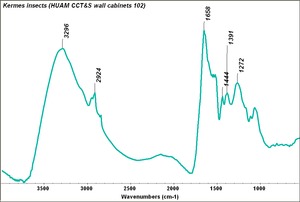
[[[SliderGallery rightalign|Kermes insects.TIF~FTIR (MFA)]]] | |||
== Synonyms and Related Terms == | == Synonyms and Related Terms == | ||
''Kermes vermilio''; Natural Red 3; CI 75460; Scharlachkoerner (Deut.); grana quermes (Esp., Port.); scarlatum (Lat.); chermes (It.); Kermes (Deut.); kermès (Fr;); kermis (Gr.); kokkos bafikos (Gr.); carminio (It.); kermes (Ned.); kermes lake; kermesic acid; grain lake; kermin berry; kermes berry; crimson lake; carmine lake | ''Kermes vermilio''; Natural Red 3; CI 75460; Scharlachkoerner (Deut.); grana quermes (Esp., Port.); scarlatum (Lat.); chermes (It.); Kermes (Deut.); kermès (Fr;); kermis (Gr.); kokkos bafikos (Gr.); carminio (It.); kermes (Ned.); kermes lake; kermesic acid; grain lake; kermin berry; kermes berry; crimson lake; carmine lake | ||
== Physical and Chemical Properties == | |||
* Kermisic acid is soluble in hot water, ethyl ether. It is slightly soluble in cold water. | |||
* In sulfuric acid, it forms a violet red that turns blue by adding boric acid. | |||
* Good washfastness with proteins | |||
* Sensitive to light, alkalinity and oxidation | |||
== Resources and Citations == | |||
== | |||
* H. Schweppe, H.Roosen-Runge, "Carmine-Cochineal Carmine and Kermes Carmine", ''Artists Pigments'', Volume 1, R. Feller (ed.), Cambridge University Press: Cambridge, 1986. | |||
* ColourLex: [https://colourlex.com/project/carmine-kermes/ Carmine Kermes] | |||
* ''Encyclopedia Britannica'', http://www.britannica.com Comment: ''Kermes ilicis'' Accessed 6 May 2004 | |||
* ''The Dictionary of Art'', Grove's Dictionaries Inc., New York, 1996 Comment: 'Pigments' | * ''The Dictionary of Art'', Grove's Dictionaries Inc., New York, 1996 Comment: 'Pigments' | ||
* Judith Hofenk-de Graaff, ''Natural Dyestuffs: Origin, Chemical Constitution, Identification'', Central Research Laboratory for Objects of Art and Science, Amsterdam, 1969 | * Judith Hofenk-de Graaff, ''Natural Dyestuffs: Origin, Chemical Constitution, Identification'', Central Research Laboratory for Objects of Art and Science, Amsterdam, 1969 | ||
* J. Thornton, 'The Use of Dyes and Colored Varnishes in Wood Polychromy', ''Painted Wood: History and Conservation'', The Getty Conservation Institute, Los Angeles, 1998 | |||
* J. Thornton, 'The Use of Dyes and Colored Varnishes in Wood Polychromy', ''Painted Wood: History and Conservation'', The Getty Conservation | |||
* R. J. Gettens, G.L. Stout, ''Painting Materials, A Short Encyclopaedia'', Dover Publications, New York, 1966 Comment: ''Coccus ilicis'' | * R. J. Gettens, G.L. Stout, ''Painting Materials, A Short Encyclopaedia'', Dover Publications, New York, 1966 Comment: ''Coccus ilicis'' | ||
* Ralph Mayer, ''A Dictionary of Art Terms and Techniques'', Harper and Row Publishers, New York, 1969 (also 1945 printing) | * Ralph Mayer, ''A Dictionary of Art Terms and Techniques'', Harper and Row Publishers, New York, 1969 (also 1945 printing) | ||
* Hermann Kuhn, ''Conservation and Restoration of Works of Art and Antiquities'', Butterworths, London, 1986 | * Hermann Kuhn, ''Conservation and Restoration of Works of Art and Antiquities'', Butterworths, London, 1986 | ||
* G.S.Brady, ''Materials Handbook'', McGraw-Hill Book Co., New York, 1971 | * G.S.Brady, ''Materials Handbook'', McGraw-Hill Book Co., New York, 1971 | ||
* Random House, ''Webster's Encyclopedic Unabridged Dictionary of the English Language'', Grammercy Book, New York, 1997 | * Random House, ''Webster's Encyclopedic Unabridged Dictionary of the English Language'', Grammercy Book, New York, 1997 | ||
* ''The American Heritage Dictionary'' or ''Encarta'', via Microsoft Bookshelf 98, Microsoft Corp., 1998 | * ''The American Heritage Dictionary'' or ''Encarta'', via Microsoft Bookshelf 98, Microsoft Corp., 1998 | ||
* Art and Architecture Thesaurus Online, https://www.getty.edu/research/tools/vocabulary/aat/, J. Paul Getty Trust, Los Angeles, 2000 | |||
* Art and Architecture Thesaurus Online, | |||
* Thomas B. Brill, ''Light Its Interaction with Art and Antiquities'', Plenum Press, New York City, 1980 | * Thomas B. Brill, ''Light Its Interaction with Art and Antiquities'', Plenum Press, New York City, 1980 | ||
* The Color of Art Pigment Database: [https://www.artiscreation.com/red.html#natural_pigments Red Pigments] | |||
* Wikipedia: [https://en.wikipedia.org/wiki/Kermes_(dye) Kermes (dye)] Accessed April 2026 | |||
[[Category:Materials database]] | [[Category:Materials database]] | ||
Latest revision as of 11:24, 8 May 2026
Description
A natural red dye obtained from the dried bodies of the female insects, Kermes vermilio Planchon and Kermes ilicis (formerly Coccus ilicis), found in southern Europe on the small evergreen kermes oak, Quercus coccifera. Kermes dye, used since ancient times, has about one-tenth the coloring power of cochineal. The primary colorant, kermesic acid, is extracted by water. Kermes also contains 18-32% tannins and is used for making a dark color leather. Crimson lake pigment was made from kermes by extraction with alkali then precipitation on alumina trihydrate. It was used by ancient Egyptians, Greeks and Romans. Crimson lake was rarely used after carmine became popular in the 16th century and its use discontinued in the 19th century with the introduction of madder and alizarin lakes.
Synonyms and Related Terms
Kermes vermilio; Natural Red 3; CI 75460; Scharlachkoerner (Deut.); grana quermes (Esp., Port.); scarlatum (Lat.); chermes (It.); Kermes (Deut.); kermès (Fr;); kermis (Gr.); kokkos bafikos (Gr.); carminio (It.); kermes (Ned.); kermes lake; kermesic acid; grain lake; kermin berry; kermes berry; crimson lake; carmine lake
Physical and Chemical Properties
- Kermisic acid is soluble in hot water, ethyl ether. It is slightly soluble in cold water.
- In sulfuric acid, it forms a violet red that turns blue by adding boric acid.
- Good washfastness with proteins
- Sensitive to light, alkalinity and oxidation
Resources and Citations
- H. Schweppe, H.Roosen-Runge, "Carmine-Cochineal Carmine and Kermes Carmine", Artists Pigments, Volume 1, R. Feller (ed.), Cambridge University Press: Cambridge, 1986.
- ColourLex: Carmine Kermes
- Encyclopedia Britannica, http://www.britannica.com Comment: Kermes ilicis Accessed 6 May 2004
- The Dictionary of Art, Grove's Dictionaries Inc., New York, 1996 Comment: 'Pigments'
- Judith Hofenk-de Graaff, Natural Dyestuffs: Origin, Chemical Constitution, Identification, Central Research Laboratory for Objects of Art and Science, Amsterdam, 1969
- J. Thornton, 'The Use of Dyes and Colored Varnishes in Wood Polychromy', Painted Wood: History and Conservation, The Getty Conservation Institute, Los Angeles, 1998
- R. J. Gettens, G.L. Stout, Painting Materials, A Short Encyclopaedia, Dover Publications, New York, 1966 Comment: Coccus ilicis
- Ralph Mayer, A Dictionary of Art Terms and Techniques, Harper and Row Publishers, New York, 1969 (also 1945 printing)
- Hermann Kuhn, Conservation and Restoration of Works of Art and Antiquities, Butterworths, London, 1986
- G.S.Brady, Materials Handbook, McGraw-Hill Book Co., New York, 1971
- Random House, Webster's Encyclopedic Unabridged Dictionary of the English Language, Grammercy Book, New York, 1997
- The American Heritage Dictionary or Encarta, via Microsoft Bookshelf 98, Microsoft Corp., 1998
- Art and Architecture Thesaurus Online, https://www.getty.edu/research/tools/vocabulary/aat/, J. Paul Getty Trust, Los Angeles, 2000
- Thomas B. Brill, Light Its Interaction with Art and Antiquities, Plenum Press, New York City, 1980
- The Color of Art Pigment Database: Red Pigments
- Wikipedia: Kermes (dye) Accessed April 2026