About CAMEO
The Conservation and Art Materials Encyclopedia Online (CAMEO) is an electronic database that compiles, defines, and disseminates technical information on the distinct collection of terms, materials, and techniques used in the fields of art conservation and historic preservation.
Project Team
The CAMEO project team has researched, entered and reviewed information almost 10,000 materials. The team is composed of:
- Editor-in-chief:* Michele Derrick, Research Scientist, retired, MFA [email protected]
- Management/supervision: Richard Newman, Head, Scientific Research Department, MFA (1997-present) and Rhona MacBeth, Chair, Conservation and Collections Management, MFA (2020-present). Previous supervisors: Arthur Beale (1997-2006) and Matthew Siegal (2007-2020)
- Imaging and Photography: Keith Lawrence, Scientific Photographer, MFA (2000-2011)
- Web design and implementation: Ronny Couseillant, Collection Systems Programmer, MFA [email protected]
- CHARISMA/CAMEO cooperation organizer: Jean Louis Boutaine, Scientist emeritus, C2RMF, Paris, France
- Fiber Reference Image Library (FRIL), senior editor: Kathryn Jakes, Professor emeritus, Ohio State University
- Dye Analysis, senior editor: Xian Zhang, Consultant scientist, MFA
- Ukiyo-e Colorants, senior editors: Michiko Adachi, Bettina Burr Associate Conservator, MFA and Joan Wright, Conservator emeritus, MFA
- Asian Textiles, senior editors:Andrew Hare, Supervisory Conservator, East Asian Painting Conservation Studio, National Museum of Asian Art ([email protected]) and Philip Meredith, Conservator emeritus, MFA
- MWG (Materials Working Group), senior editors: Rachael Arenstein, A.M. Art Conservation LLC and Jenifer Bosworth, Exhibitions Conservator, National Museum of Asian Art
Additional editors:
| Austria | Poland | USA | USA |
| * Manfred Schreiner, ABK, Wien | * Piotr Targowski, UMK, Toruń | * Alison Luxner, MFA, Boston, MA | * Colleen Snyder, Cleveland Mus. of Art, OH |
| Canada | * Elzbieta Basiul, UMK, Toruń | * Odile Madden, Smithsonian MCI, Washington DC | * Samantha Springer, Portland Mus. of Art, OR |
| * Marie-Claude Corbeil, CCI, Ottawa | * Teresa Kurkiewicz, UMK, Toruń | * Gwen Manthey, Smithsonian AAM, Washington DC | * Kristin Stacy, MFA, Boston MA |
| * Marilyn Laver, Lavinco CSS, Toronto | * Jaroslaw Rogoz, UMK, Toruń | * Katherine Langdon, Urbana IL | * Catherine Stephens, Mus. of Modern Art, NY |
| France | Portugal | * Nora Lockshin, Smithsonian Archives, Wash. DC | * Margaret Scollan, MFA, Boston MA |
| * Michel Dubus, C2RMF, Paris | * José Delgado Rodrigues, LNEC, Lisboa | * Cuong Nguyen, Henry Ford, Dearborn MI | * Tanya Uyeda, MFA, Boston MA |
| * Anne-Solenn Le Ho, C2RMF, Paris | * Joao Manuel Mimoso, LNEC, Lisboa | * Susan Peckham, Library of Congress, DC | * Pam Young, Colonial Williamsburg, VA |
| Germany | Singapore | * Rachael Arenstein, A.M. Art Conservation, NY | * Kirsten Moffitt, Colonial Williamsburg, VA |
| * Sven Bittner, BLFD, Muenchen | * Bodil Unckel, National Gallery of Singapore | * Jocelyn Alcantara-Garcia, Univ. Delaware, Newark | * Kisook Suh, Metropolitan Mus., NYC, NY |
| * Sylvia Mitschke, CEZA, Mannheim | Spain | * Monica Berry, Monica Berry Art Conservation, NY | * Richard Laursen, Boston University, MA |
| Greece | * Maria Dolores Gayo, MNP, Madrid | * Charlotte Ameringer, MFA, Boston | * Sarah Thompson, Menil Collection, Houston TX |
| * Sophia Sotiropoulou, OADC, Ormylia, Chalkidiki | * Maite Jover, MNP, Madrid | * Monica Berry, Monica Berry Art Conservation, NY | * Tina Qin, Michigan State University, East Lansing MI |
| Hungary | * Carmen Muro, MNCARS, Madrid | * Luisa Casella, Luisa Casella Conservation, NY | * Amanda Jones, Library of Congress, Washington DC |
| * Laszlo Rosta, BNC, Budapest | UK | * Virginia G. Ethier, MFA, Boston MA | * Matthew Kullman, Library of Congress, DC |
| Italy | * Morena Ferreira, Cardiff University, Cardiff | * Fenella France, Library of Congress, DC | * Natasha Kung, Metropolitan Museum, NY |
| * Susanna Bracci, CNR-ICVBC, Firenze | * Adelheid Hansen, Adelheid Hansen Conservation, Stroud | * Jennifer French, NCDCR, Washington DC* | |
| * Giancarlo Lanterna, OPD, Firenze | * Jo Kirby, NGL, London | * Emily Frank, Yale University Art Gallery, New Haven CT | |
| Netherlands | * Joseph Padfield, NGL, London | * Ozge Gencay-Ustun, Autry Museum, LA CA | |
| * Ineke Joosten, RCE, Amsterdam | * James Peake, Cardiff University, Cardiff | * Emma Guerard, Los Angeles County Art Museum, LA CA | |
| * Alberto de Tagle, RCE, Amsterdam | * Ashok Roy, NGL, London | * Abed Haddad, MOMA, New York City NY | |
| * | * Marika Spring, NGL, London | * Abigail Hykin, MFA, Boston MA | |
| * | * Joyce Townsend, Tate Gallery, London | * Suzanne Hargrove, Toledo Museum, Toledo OH |
History of CAMEO
In 1997, a database formerly called the Conservation and Art Materials Dictionary (CAMD), was developed at the Museum of Fine Arts, Boston (MFA) by the Conservation and Collections Management Department under the direction of Arthur Beale, Chair of the Conservation Department at the MFA. An initial grant from the National Center for Preservation Technology and Training (NCPTT) along with additional resources and support from the MFA enabled the first version of the database to be placed on the Internet in November 2000.
In the development phase, to ensure complete coverage from the diverse specialties within museums and conservation, six initial contributors/reviewers (Gordon Hanlon, Pamela Hatchfield, Teresa Hensick, Meredith Montague, Ivan Myjer, and Roy Perkinson) supplied entries of materials and reviewed draft versions of the database. Michele Derrick, the principal investigator, compiled, consolidated, condensed, and entered available information into the database program. The MFA Webmaster, Phil Getchell, and consultant John Klick developed an online application that allowed interactive, searchable access to the data. After beta testing by the conservation and curatorial staff at the Museum, the database was uploaded to the Internet for use and review by the worldwide conservation community. It was immediately hailed as an important resource for the field.
Soon it was deemed important for CAMEO to have an upgraded structure as well as for its coverage and content to be expanded into a more comprehensive and well-rounded encyclopedic resource for the art conservation and historic preservation fields. In October 2002, a two-year National Leadership grant from the Institute of Museum Library Services (IMLS) allowed the transport of CAMEO to a SQL based system to better handle the volume of users and information. Major additions to the database included added auxiliary pages for images and documentation of the authority trail. A companion database containing a directory of conservation-related organizations was also added. The IMLS grant ended with all projected tasks completed, including the addition of approximately 6,000 images. In July 2005, a two-year grant from the Andrew W. Mellon Foundation provided support to upgrade the appearance and user functionality of CAMEO. Mediatrope, a professional web development firm, was selected to redesign the website and implement upgrades. New features include auxiliary COMPARISON pages and a third database for information on the Forbes Pigment Collection.
In 2013, with a grant from the Kress Foundation, CAMEO was transferred from the proprietary software and placed on a MediaWiki platform by Josh Sostek, MFA Web developer, and Tim Benson, consultant. This major transformation heralds a new era for CAMEO because it opens the database to the option of data entry by many volunteer editors. This update provides the flexibility to keep editorial restrictions while also allowing easier, wide-spread contributions for revising and expanding the scope and content of our multi-functional information source.
This transformation of CAMEO to a wiki also included the creation of two new major information resources. These are both related to the use and analysis of natural and synthetic dyes in works of art. The first resource is the documentation of the Uemura collection of dyed fabrics that was acquired by the MFA in 2008. A database containing the original Japanese text with its English translation was created by Masumi Kataoka, Sherman Fairchild Fellow in Textile Conservation. Images of all of the dyed samples were collected by Keith Lawrence, Scientific photographer. The second new resource, DYE ANALYSIS, is seminal to the scientific art analysis world because it provides critical analytical parameters for the analysis of synthetic and natural dyes using state-of-the-art liquid chromatographic and mass spectrometric equipment. This database will contain the results from a joint project funded by NSF between Richard Newman, Simmons College, and Boston University. Integral to this data is the analysis of all the reference samples in the Uemura collection. The site is organized into categories of Natural and Synthetic Dyes with sub-categories of dyes found on cultural artifacts. Dr. Xian Zhang is the senior editor for DYE ANALYSIS.

In 2016, CAMEO was featured as the lead article in Chemistry International, the news magazine for the International Union of Pure and Applied Chemistry. Please read the article at: http://www.degruyter.com/view/j/ci.2016.38.issue-5/ci-2016-0500/ci-2016-0500.xml?format=INT
In 2017, CAMEO welcomed the addition of FRIL (Fiber Reference IMAGE Library). This is a database of images of textile fibers acquired through the use of multiple microscopic techniques (brightfield, darkfield, polarized light, and differential interference contrast) to provide complementary information contributing to identification and characterization. The site is organized into categories of Plant, Animal, and Manufactured fibers with sub-categories to include images of fibers from 18th through 21st century garments. Dr. Kathryn Jakes, is the senior editor for FRIL.
In 2018 a new initiative was launched by Rachel Arenstein, Samantha Springer, and Colleen Snyder to coordinate volunteer editors specifically working on increasing the number of bilateral links between CAMEO and the American Institute for Conservation WIKI (http://www.conservation-wiki.com/wiki/Main_Page). These two resources provide complementary information since CAMEO is a technical encyclopedia of materials while the AIC WIKI provides information on the use of the materials for the conservation of works of art. For examples of the information in each, please start at the CAMEO entries for Starch or Fiberboard. For additional information, contact [email protected].
Also in 2018, CAMEO received funds to support its future growth from:
- ANAGPIC (the Association of North American Graduate Programs in Conservation)
- Department of Art Conservation, University of Delaware (in honor of Bruno Pouliot and Vicki Cassman)
- Anonymous (in honor of Bruno Pouliot)
These funds were used to establish a second parallel cloud server with the most up-to-date production versions of the MEDIAWIKI software containing numerous extensions that add more functionality. The CAMEO application was extracted, moved, and tested on the new server, while the public accessible version of CAMEO is maintained on its existing server. Once all CAMEO information is transferred to the developmental server and vetted as operational, the public will have access to CAMEO on the most current version of MEDIAWIKI. The MFA will continue to fund both servers, with the initial server then becoming the developmental version. The continuity of the two servers will allow the MFA to continually improve and add to the CAMEO database without interrupting the day-to-day operation.
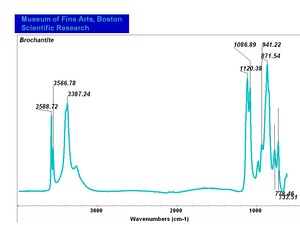
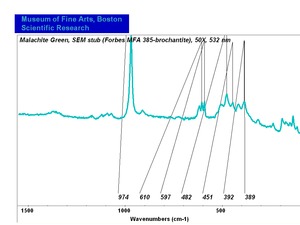


In 2019, we began a concerted effort is currently underway to evaluate and upgrade the analytical spectra that are presented in CAMEO. This primarily includes examining current Infrared and Raman spectra to ensure their accuracy as well as to provide images with wavelength markers for the major peaks. See for example the Brochantite slider gallery shown on this page. For this particular sample, the Forbes pigment jar was labeled ‘Malachite Green’, but all analysis techniques confirmed its identity to be brochantite. One of our efforts has been directed toward correctly identifying the pigments in the Forbes reference set. The major work on MFA contributions is being done by Dr. Erin Mysak. Concurrently, Dr. Abed Haddad, the David Booth Fellow in Conservation Science from the Museum of Modern Art in New York City is examining and contributing to the Raman reference set.
Support for these updates were received from:
- Sotheby’s Scientific Research Department
Beginning in 2019, The Materials Selection and Specification Working Group (MWG) at the American Institute for Conservation (AIC) is leading an effort to provide a resource bank of information that will help develop best practices in selection of materials used in the preservation, transport, and display of cultural heritage. CAMEO has been designated as the platform for the consolidated information on materials with new sets of information added under the headers: Applications, Personal Risks, Collection Risks, Environmental Risks, Working Properties, and Forms/Sizes. The ‘Additional Information’ field will contain links to the Oddy Test results residing in the AIC Wiki. The ‘Environmental Risks’ section will be populated with information developed as part of the recently funded NEH grant for Life Cycle Assessment of materials and treatments used in cultural conservation. CAMEO will also provide links to the Life Cycle Assessment tool that will enable the comparison of carbon footprints for over 3000 materials.
In July 2020, The Freer Gallery of Art and Arthur M. Sackler Gallery, the Smithsonian’s National Museum of Asian Art, in cooperation with the MFA has created the Asian Textile Database, an open-access resource to facilitate the international study and appreciation of Asian textiles. This project began in 2005 as a digital inventory of textiles used to mount East Asian scrolls. While working with textile scholars, conservators realized the impact this growing resource of technical data could have on research in the field. Because historic Asian textiles are inherently fragile and scattered in collections across the globe, access is often restricted, making comparative analysis difficult. Research is siloed because there is no repository of data that is generally available and consistently updated. The Asian Textile Database is a Wikimedia database that provides a centralized data source and invites researchers, conservators, and conservation scientists to share information about collections and cooperate in building this international research tool.

Additionally, in July 2020, the CAMEO homepage received a new logo and page layout. This design is the work of Scott Na'auao of Welcome Stranger. We very much appreciate his generosity.
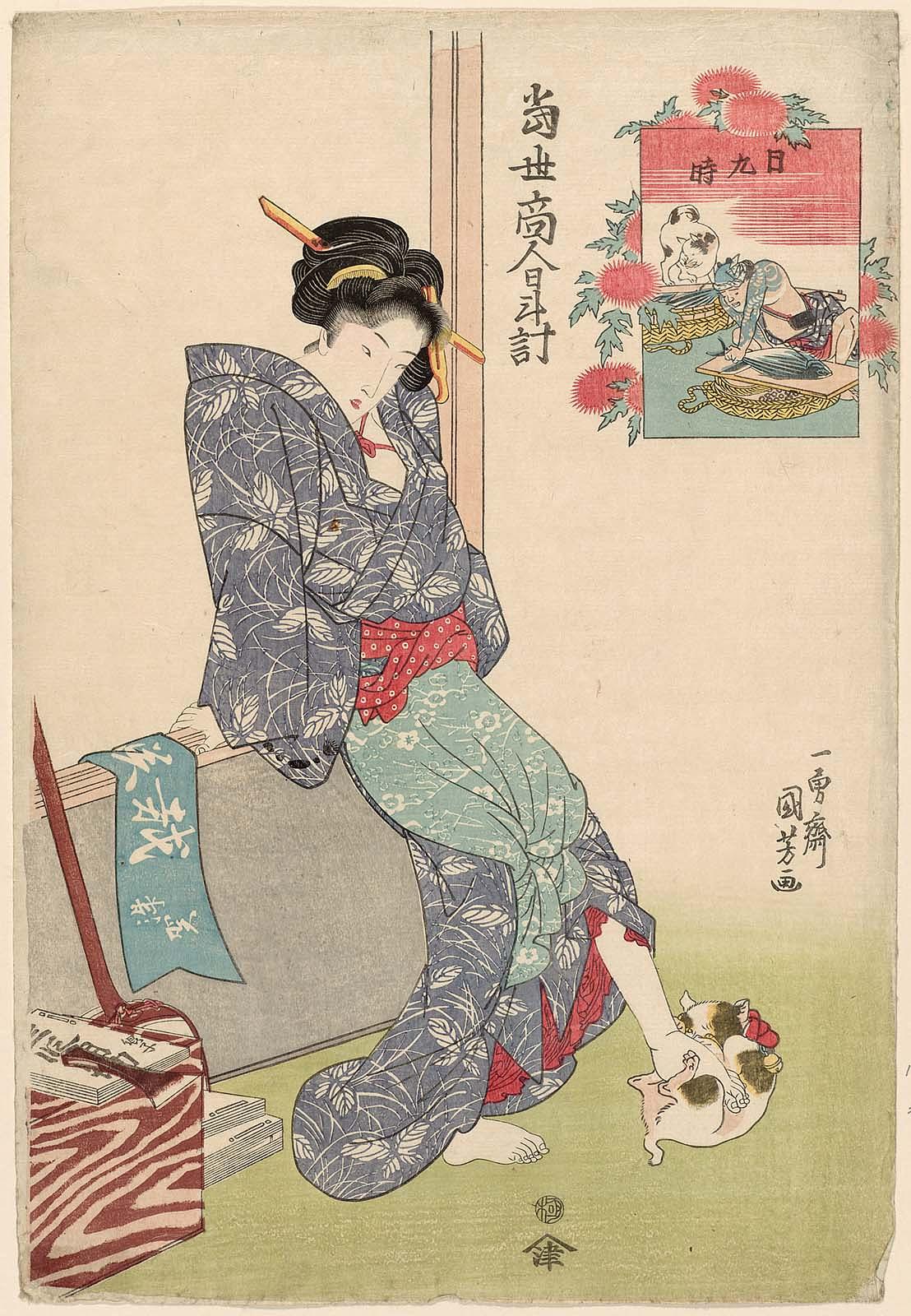
In September, 2025, the [Ukiyo-e Print Colorant Database] was officially release to the public on the CAMEO website. This data collection has been the joint research project of the Asian Conservation Studio and Scientific Research Laboratory at the Museum of Fine Arts, Boston (MFA). The research was based on the identification of colorants used in Japanese woodblock prints from the Edo period (1603–1868). The combined perspectives of the conservators, who are familiar with the practical use of materials and their physical characteristics along with the scientists’ expertise in analysis and interpretation of data. This project has relied solely on non-invasive techniques that do not require sampling from prints.
CAMEO Partnership
In 2006, the MFA formed a collaborative agreement with EU-Artech (Access, Research and Technology for the conservation of European Cultural Heritage) to increase the international scope of CAMEO. In 2010, this partnership was redeveloped and extended with the CHARISMA (Cultural Heritage Advanced Research Infrastructures) European research project consortium that focuses on providing transnational access, doing cooperative research, and networking applications in the field of cultural heritage conservation.
With this partnership, members have contributed European language synonyms, images, and information to CAMEO as well as provided systematic review of the material records. To date, over 9000 non-English synonyms have been added to the database as an aid for searching records. Now users can enter either English or non-English terms into the MATERIAL search box. Both the primary name and the synonym list are searched simultaneously to locate a material record. This collaboration has helped expand the reach of the website into a broadly-used international resource. Examination of the website statistics shows that CAMEO has logged over 300,000 page views by users in over 200 countries over the past 12 months.
CHARISMA partners include:
- Akademie der bildenden Künste (ABK), Wien, Austria
- Bayerisches Landesamt für Denkmalpflege (BLFD), München, Germany
- Budapest Neutron Centre (BNC), Budapest, Hungary
- Centre de Recherche et de Restauration des Musées de France (C2RMF), Paris, France
- CNR - Istituto per la Conservazione e la Valorizzazione dei Beni Culturali (ICVBC), Firenze, Italy
- Curt-Engelhorn-Zentrum Archäometrie (CEZA), Mannheim, Germany
- Rijksdienst voor het Cultureel Erfgoed (RCE, formerly ICN), Asterdam, Netherlands
- Laboratorio Nacional de Engenharia Civil (LNEC), Lisboa, Portugal
- Museo Nacional del Prado (MNP), Madrid, Spain
- Museo Nacional Centro Arte Reina Sofia (MNCARS), Madrid, Spain
- National Gallery (NGL), London, United Kingdom
- Opficio delle Pietre Dure (OPD), Firenze, Italy
- Ormylia Foundation - Art Diagnosis Centre(Of-ADC), Ormylia - Chalkidiki, Greece
- Tate Gallery (TG), London, United Kingdom
- Uniwersytet Mikolaja Kopernika (UMK), Torun, Poland