Bamboo: Difference between revisions
JMcGlinchey (talk | contribs) |
No edit summary |
||
| (12 intermediate revisions by 3 users not shown) | |||
| Line 1: | Line 1: | ||
[[File:43.1303-SC120506.jpg|thumb| | [[File:43.1303-SC120506.jpg|thumb|Bamboo fan <br>MFA #: 43.1303]] | ||
== Description == | == Description == | ||
The common name for any tall woody | The common name for any tall, woody, evergreen plants that grow abundantly in tropical and subtropical areas. Bamboos, with over 480 species, belong to the family Gramineae and the most widely known bamboos come from the ''Bambusa'' genera. The woody, jointed stems, called culms, grow to 50 m (164 feet) in height. The fast-growing plants contain large amounts of protein and very low amounts of carbohydrates which makes them an ideal source of food for many animals, such as pandas and gorillas. Bamboo is a dominant raw, material in Asia where there is an extensive cultivation industry. The wood has been used locally for constructing houses, rafts, poles, bridges, and scaffolding. Exports of bamboo stems to Europe and the Americas in the 19th century were popular for chairs, tables, cabinets, and other interior furniture. They are also split, flattened and woven into smaller items such as baskets, mats, hats, and fish traps. Bamboo has also become an important source of long, cellulose fibers for specialty papers. Additionally, a wax is extracted from the bamboo leaves that has properties similar to [[candelilla wax]]. Bamboo ash has been used as a natural cleaning agent because of its abrasive and absorbent properties. Additionally, bamboo prunings and leaves have been used to produce golden yellow dyes. | ||
[[File:17.2097-SC24670.jpg|thumb|]] | [[File:17.2097-SC24670.jpg|thumb|Chinese panpipes<br>MFA# 17.2097]] | ||
== Synonyms and Related Terms == | == Synonyms and Related Terms == | ||
| Line 10: | Line 10: | ||
Bambusa; Bambus (Dan., Deut., Nor., Pol.); bambú (Esp., It.); bambou (Fr.); bamboe (Ned.); bambu (Port.) | Bambusa; Bambus (Dan., Deut., Nor., Pol.); bambú (Esp., It.); bambou (Fr.); bamboe (Ned.); bambu (Port.) | ||
== | ==Applications== | ||
* Wood is used for construction, furniture, weapons, and musical instruments | |||
* Cut stems can be shaped into utensils, jewelry, weapons as well as woven for baskets and crafts | |||
* Shoots are used for food | |||
* Fibers and pulp are used for paper and textiles | |||
* Charcoal is used as a fuel source and light filaments while the ash is used in filters, cleaning supplies and as a concrete filler (see [[Bamboo ash]]) | |||
==Bamboo species== | |||
(Table source: Guadua Bamboo 2023) | |||
{| class="wikitable" | |||
|- | |||
! Bamboo species | |||
! Soil type | |||
! Climatic conditions | |||
! Uses | |||
|- | |||
| Bambusa tulda Roxb. | |||
| Common on flat alluvial soil along streams in mixed deciduous forests, loamy, fertile and well drained | |||
| Tropical to sub-tropical conditions | |||
| Pulp and paper, lumber, Agarbatti sticks, handicrafts, food | |||
|- | |||
| Bambusa bambos (L.) Voss | |||
| Nearly all types of soil having good drainage, however sandy loams, alluvial soils and slightly acidic soils exhibit superior growth | |||
| Tropical to sub-tropical conditions | |||
| Construction, scaffolding, ladders, furniture, pulp and paper, food and fodder | |||
|- | |||
| Bambusa balcooa Roxb. | |||
| Grows in wide variety of soil types but heavy textured soil with adequate drainage is most productive | |||
| Tropical to sub-tropical conditions | |||
| Scaffolding, construction, ladders, Agarbatti sticks, food, paper | |||
|- | |||
| Bambusa polymorpha Munro | |||
| Well drained alluvial and loamy soils | |||
| Tropical to sub-tropical conditions | |||
| House construction, woven matting, baskets, furniture, handicrafts, paper, pulp and board making, edible shoots with a distinctly sweet taste, landscaping. | |||
|- | |||
| Bambusa nutans Wall. ex Munro | |||
| Well drained sandy loam to clayey loam | |||
| Tropical | |||
| Baskets, fences, roofs and roof tiles, paper, treating inflammation, ulcers and wounds | |||
|- | |||
| Dendrocalamus asper (Schult. & Schult.f.) Backer | |||
| Well drained black soils, Sandy clay loam or shallow lateritic soil mixed with fine sandy clay. Good drainage is vital. | |||
| Sub-tropical to tropical. Suitable for drier zones | |||
| High quality edible shoots, construction | |||
|- | |||
| Dendrocalamus hamiltonii Nees & Arn. ex Munro | |||
| Wide variety of soils with good drainage, sandy loam soils are most suitable | |||
| Tropical to sub-tropical | |||
| Young shoots are widely consumed as vegetables, construction (houses, bridges), pulp and paper | |||
|- | |||
| Thyrsostachys oliveri Gamble | |||
| Well drained loamy soils | |||
| Tropical | |||
| Construction, furniture, baskets, umbrellas, fishing rods, sports goods, edible shoots | |||
|- | |||
| Melocanna baccifera (Roxb.) Kurz | |||
| Moist sandy, clay loam alluvial soils, well drained residual soils. | |||
| Tropical to sub-tropical | |||
| Edible shoots, famine food, leaves for brewing liquor, Tabashir - a siliceous concretion found in the culms of the bamboo stem, can be collected from the culms and used as a tonic in treating respiratory diseases. | |||
|- | |||
| Dendrocalamus strictus (Roxb.) Nees | |||
| Sandy loam soil with good drainage | |||
| Tropical to sub-tropical | |||
| Pulp and paper, construction, furniture, mats, sticks, baskets, household utensils, food | |||
|} | |||
== Physical and Chemical Properties == | |||
Bamboo wax: melting point=78-80, density=0.961, iodine value=7.8, acid value=14.5, saponification value=43.4, | |||
Paper fiber type: Non-woody/grass. Using transmitted light microscopy, fibers appear long, narrow and thick-walled. Pitted vessels (some very wide), barrel-shaped and rectangular parenchyma cells are also present. Unlike other grasses, bamboo does not have serrated epidermal cells. Appearance with [[Graff "C" stain]]: reddish blue. Average dimensions of fibers: length 2.7mm; width 14μm. Common pulping method: [[kraft process|kraft]]. | Paper fiber type: Non-woody/grass. Using transmitted light microscopy, fibers appear long, narrow and thick-walled. Pitted vessels (some very wide), barrel-shaped and rectangular parenchyma cells are also present. Unlike other grasses, bamboo does not have serrated epidermal cells. Appearance with [[Graff "C" stain]]: reddish blue. Average dimensions of fibers: length 2.7mm; width 14μm. Common pulping method: [[kraft process|kraft]]. | ||
== | == Risks == | ||
Combustible. | * Combustible. | ||
* May cause allergic reactions | |||
== Additional Images == | == Additional Images == | ||
| Line 32: | Line 93: | ||
File:bamboo_proc_det.jpg|Bamboo fibers | File:bamboo_proc_det.jpg|Bamboo fibers | ||
File:Bamboo 10x.jpg|Bamboo pulp stained with Graff "C" stain | File:Bamboo 10x.jpg|Bamboo pulp stained with Graff "C" stain | ||
File:Bamboo 40x.jpg|Bamboo pulp stained with Graff "C" stain | |||
</gallery> | </gallery> | ||
== | == Resources and Citations == | ||
* Wikipedia: [https://en.wikipedia.org/wiki/Bamboo Bamboo] (Accessed July 2025) | |||
* G.S.Brady, ''Materials Handbook'', McGraw-Hill Book Co., New York, 1971 Comment: p. 83 | * G.S.Brady, ''Materials Handbook'', McGraw-Hill Book Co., New York, 1971 Comment: p. 83 | ||
* Ralph Mayer, ''A Dictionary of Art Terms and Techniques'', Harper and Row Publishers, New York, 1969 (also 1945 printing) | * Ralph Mayer, ''A Dictionary of Art Terms and Techniques'', Harper and Row Publishers, New York, 1969 (also 1945 printing) | ||
* Matt Roberts, Don Etherington, ''Bookbinding and the Conservation of Books: a Dictionary of Descriptive Terminology'', U.S. Government Printing Office, Washington DC, 1982 | * Matt Roberts, Don Etherington, ''Bookbinding and the Conservation of Books: a Dictionary of Descriptive Terminology'', U.S. Government Printing Office, Washington DC, 1982 | ||
* Gordon Hanlon, contributed information, 1998 | * Gordon Hanlon, contributed information, 1998 | ||
* E.J.LaBarre, ''Dictionary and Encyclopedia of Paper and Paper-making'', Swets & Zeitlinger, Amsterdam, 1969 | * E.J.LaBarre, ''Dictionary and Encyclopedia of Paper and Paper-making'', Swets & Zeitlinger, Amsterdam, 1969 | ||
* ''Van Nostrand's Scientific Encyclopedia'', Douglas M. Considine (ed.), Van Nostrand Reinhold, New York, 1976 | * ''Van Nostrand's Scientific Encyclopedia'', Douglas M. Considine (ed.), Van Nostrand Reinhold, New York, 1976 | ||
* Walter Rantanen. "Fiber ID Course." Integrated Paper Services. June 2013. Lecture. | * Walter Rantanen. "Fiber ID Course." Integrated Paper Services. June 2013. Lecture. | ||
* Random House, ''Webster's Encyclopedic Unabridged Dictionary of the English Language'', Grammercy Book, New York, 1997 | * Random House, ''Webster's Encyclopedic Unabridged Dictionary of the English Language'', Grammercy Book, New York, 1997 | ||
* ''The American Heritage Dictionary'' or ''Encarta'', via Microsoft Bookshelf 98, Microsoft Corp., 1998 | * ''The American Heritage Dictionary'' or ''Encarta'', via Microsoft Bookshelf 98, Microsoft Corp., 1998 | ||
* F. Kidd, ''Brushmaking Materials'', Bristish Brush Manufacturers, London, 1957 | * F. Kidd, ''Brushmaking Materials'', Bristish Brush Manufacturers, London, 1957 | ||
* Richard S. Lewis, ''Hawley's Condensed Chemical Dictionary'', Van Nostrand Reinhold, New York, 10th ed., 1993 | * Richard S. Lewis, ''Hawley's Condensed Chemical Dictionary'', Van Nostrand Reinhold, New York, 10th ed., 1993 | ||
* Tom Rowland, Noel Riley, ''A-Z Guide to Cleaning, Conserving and Repairing Antiques'', Constable and Co., Ltd., London, 1981 | * Tom Rowland, Noel Riley, ''A-Z Guide to Cleaning, Conserving and Repairing Antiques'', Constable and Co., Ltd., London, 1981 | ||
* ''CRC Handbook of Chemistry and Physics'', Robert Weast (ed.), CRC Press, Boca Raton, Florida, v. 61, 1980 Comment: wood: density=19-25 ppcf (0.31-0.40 g/cm3) - wax: melting point=78-80, density=0.961, iodine value=7.8, acid value=14.5, saponification value=43.4 | * ''CRC Handbook of Chemistry and Physics'', Robert Weast (ed.), CRC Press, Boca Raton, Florida, v. 61, 1980 Comment: wood: density=19-25 ppcf (0.31-0.40 g/cm3) - wax: melting point=78-80, density=0.961, iodine value=7.8, acid value=14.5, saponification value=43.4 | ||
* Marja-Sisko Ilvessalo-Pfäffli. ''Fiber Atlas: Identification of Papermaking Fibers'' (Springer Series in Wood Science). Springer, 1995. | * Marja-Sisko Ilvessalo-Pfäffli. ''Fiber Atlas: Identification of Papermaking Fibers'' (Springer Series in Wood Science). Springer, 1995. | ||
* Guadua Bamboo, 2023. Guadua bamboo experts in the world's strongest bamboo. [https://www.guaduabamboo.com/ Link] | |||
[[Category:Materials database]] | [[Category:Materials database]] | ||
Latest revision as of 15:58, 13 May 2026

Description
The common name for any tall, woody, evergreen plants that grow abundantly in tropical and subtropical areas. Bamboos, with over 480 species, belong to the family Gramineae and the most widely known bamboos come from the Bambusa genera. The woody, jointed stems, called culms, grow to 50 m (164 feet) in height. The fast-growing plants contain large amounts of protein and very low amounts of carbohydrates which makes them an ideal source of food for many animals, such as pandas and gorillas. Bamboo is a dominant raw, material in Asia where there is an extensive cultivation industry. The wood has been used locally for constructing houses, rafts, poles, bridges, and scaffolding. Exports of bamboo stems to Europe and the Americas in the 19th century were popular for chairs, tables, cabinets, and other interior furniture. They are also split, flattened and woven into smaller items such as baskets, mats, hats, and fish traps. Bamboo has also become an important source of long, cellulose fibers for specialty papers. Additionally, a wax is extracted from the bamboo leaves that has properties similar to candelilla wax. Bamboo ash has been used as a natural cleaning agent because of its abrasive and absorbent properties. Additionally, bamboo prunings and leaves have been used to produce golden yellow dyes.

Synonyms and Related Terms
Bambusa; Bambus (Dan., Deut., Nor., Pol.); bambú (Esp., It.); bambou (Fr.); bamboe (Ned.); bambu (Port.)
Applications
- Wood is used for construction, furniture, weapons, and musical instruments
- Cut stems can be shaped into utensils, jewelry, weapons as well as woven for baskets and crafts
- Shoots are used for food
- Fibers and pulp are used for paper and textiles
- Charcoal is used as a fuel source and light filaments while the ash is used in filters, cleaning supplies and as a concrete filler (see Bamboo ash)
Bamboo species
(Table source: Guadua Bamboo 2023)
| Bamboo species | Soil type | Climatic conditions | Uses |
|---|---|---|---|
| Bambusa tulda Roxb. | Common on flat alluvial soil along streams in mixed deciduous forests, loamy, fertile and well drained | Tropical to sub-tropical conditions | Pulp and paper, lumber, Agarbatti sticks, handicrafts, food |
| Bambusa bambos (L.) Voss | Nearly all types of soil having good drainage, however sandy loams, alluvial soils and slightly acidic soils exhibit superior growth | Tropical to sub-tropical conditions | Construction, scaffolding, ladders, furniture, pulp and paper, food and fodder |
| Bambusa balcooa Roxb. | Grows in wide variety of soil types but heavy textured soil with adequate drainage is most productive | Tropical to sub-tropical conditions | Scaffolding, construction, ladders, Agarbatti sticks, food, paper |
| Bambusa polymorpha Munro | Well drained alluvial and loamy soils | Tropical to sub-tropical conditions | House construction, woven matting, baskets, furniture, handicrafts, paper, pulp and board making, edible shoots with a distinctly sweet taste, landscaping. |
| Bambusa nutans Wall. ex Munro | Well drained sandy loam to clayey loam | Tropical | Baskets, fences, roofs and roof tiles, paper, treating inflammation, ulcers and wounds |
| Dendrocalamus asper (Schult. & Schult.f.) Backer | Well drained black soils, Sandy clay loam or shallow lateritic soil mixed with fine sandy clay. Good drainage is vital. | Sub-tropical to tropical. Suitable for drier zones | High quality edible shoots, construction |
| Dendrocalamus hamiltonii Nees & Arn. ex Munro | Wide variety of soils with good drainage, sandy loam soils are most suitable | Tropical to sub-tropical | Young shoots are widely consumed as vegetables, construction (houses, bridges), pulp and paper |
| Thyrsostachys oliveri Gamble | Well drained loamy soils | Tropical | Construction, furniture, baskets, umbrellas, fishing rods, sports goods, edible shoots |
| Melocanna baccifera (Roxb.) Kurz | Moist sandy, clay loam alluvial soils, well drained residual soils. | Tropical to sub-tropical | Edible shoots, famine food, leaves for brewing liquor, Tabashir - a siliceous concretion found in the culms of the bamboo stem, can be collected from the culms and used as a tonic in treating respiratory diseases. |
| Dendrocalamus strictus (Roxb.) Nees | Sandy loam soil with good drainage | Tropical to sub-tropical | Pulp and paper, construction, furniture, mats, sticks, baskets, household utensils, food |
Physical and Chemical Properties
Bamboo wax: melting point=78-80, density=0.961, iodine value=7.8, acid value=14.5, saponification value=43.4,
Paper fiber type: Non-woody/grass. Using transmitted light microscopy, fibers appear long, narrow and thick-walled. Pitted vessels (some very wide), barrel-shaped and rectangular parenchyma cells are also present. Unlike other grasses, bamboo does not have serrated epidermal cells. Appearance with Graff "C" stain: reddish blue. Average dimensions of fibers: length 2.7mm; width 14μm. Common pulping method: kraft.
Risks
- Combustible.
- May cause allergic reactions
Additional Images

Bamboo
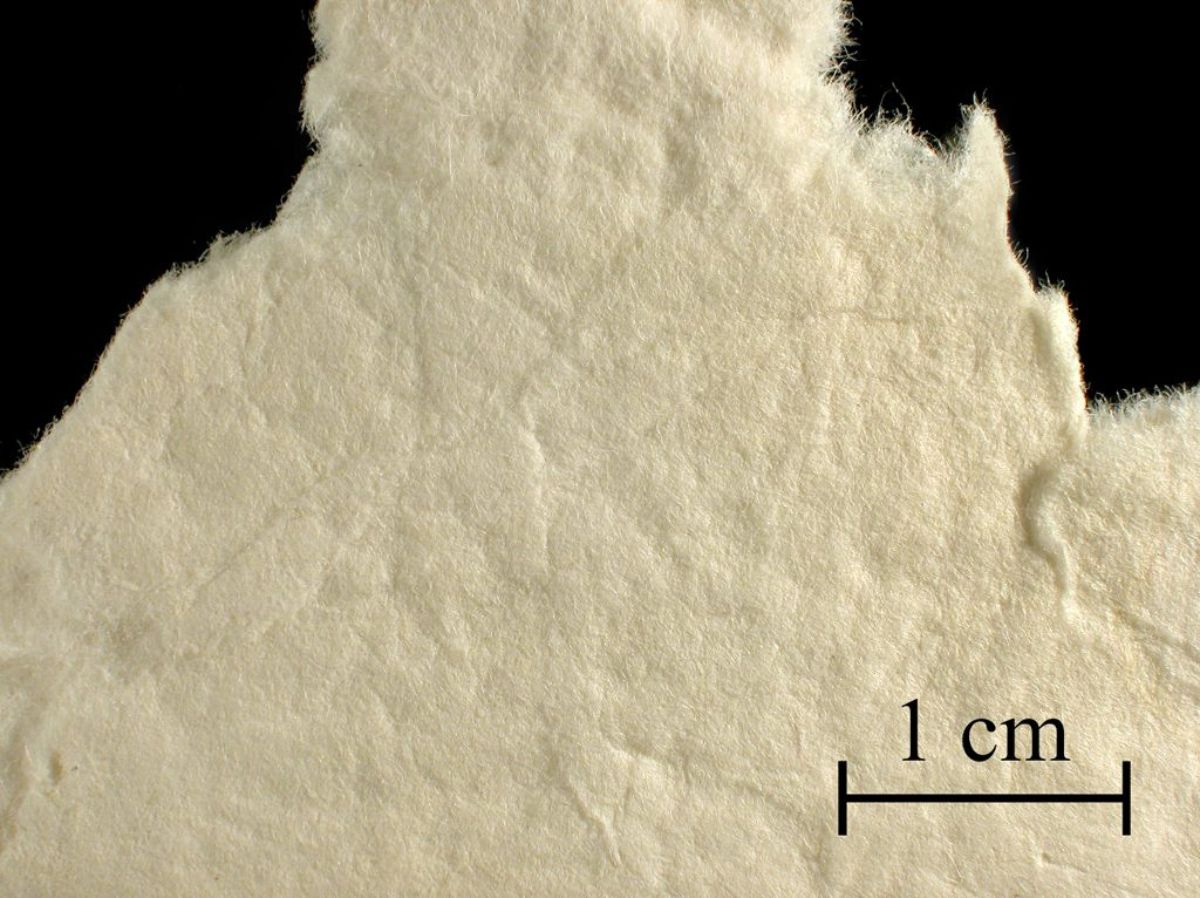
Bamboo fibers

Bamboo pulp stained with Graff "C" stain

Bamboo pulp stained with Graff "C" stain


Resources and Citations
- Wikipedia: Bamboo (Accessed July 2025)
- G.S.Brady, Materials Handbook, McGraw-Hill Book Co., New York, 1971 Comment: p. 83
- Ralph Mayer, A Dictionary of Art Terms and Techniques, Harper and Row Publishers, New York, 1969 (also 1945 printing)
- Matt Roberts, Don Etherington, Bookbinding and the Conservation of Books: a Dictionary of Descriptive Terminology, U.S. Government Printing Office, Washington DC, 1982
- Gordon Hanlon, contributed information, 1998
- E.J.LaBarre, Dictionary and Encyclopedia of Paper and Paper-making, Swets & Zeitlinger, Amsterdam, 1969
- Van Nostrand's Scientific Encyclopedia, Douglas M. Considine (ed.), Van Nostrand Reinhold, New York, 1976
- Walter Rantanen. "Fiber ID Course." Integrated Paper Services. June 2013. Lecture.
- Random House, Webster's Encyclopedic Unabridged Dictionary of the English Language, Grammercy Book, New York, 1997
- The American Heritage Dictionary or Encarta, via Microsoft Bookshelf 98, Microsoft Corp., 1998
- F. Kidd, Brushmaking Materials, Bristish Brush Manufacturers, London, 1957
- Richard S. Lewis, Hawley's Condensed Chemical Dictionary, Van Nostrand Reinhold, New York, 10th ed., 1993
- Tom Rowland, Noel Riley, A-Z Guide to Cleaning, Conserving and Repairing Antiques, Constable and Co., Ltd., London, 1981
- CRC Handbook of Chemistry and Physics, Robert Weast (ed.), CRC Press, Boca Raton, Florida, v. 61, 1980 Comment: wood: density=19-25 ppcf (0.31-0.40 g/cm3) - wax: melting point=78-80, density=0.961, iodine value=7.8, acid value=14.5, saponification value=43.4
- Marja-Sisko Ilvessalo-Pfäffli. Fiber Atlas: Identification of Papermaking Fibers (Springer Series in Wood Science). Springer, 1995.
- Guadua Bamboo, 2023. Guadua bamboo experts in the world's strongest bamboo. Link