Trifarium: Difference between revisions
(Created page with " == Description == A shiny, non-tarnishing metal alloy patented by the Trifari company in 1947. This casting metal was available as either a "golden-toned Trifanium" or a "p...") |
|||
| (15 intermediate revisions by the same user not shown) | |||
| Line 1: | Line 1: | ||
[[File:OveralllaNonaPorta.jpg|thumb|Gold-color Trifarium bracelet]] | |||
[[File:Overall neck vintage.jpg|thumb|Silver-color Trifarium necklace]] | |||
== Description == | |||
A shiny, non-tarnishing metal alloy patented by the Trifari company in 1947. The castings were filed, polished, and then plated with either gold or rhodium to produce either a "golden-toned Trifanium" or a "platinum-toned Trifanium". Trifari used the Trifarium alloy to create their costume jewelry starting in 1948 and it was used in almost all of their pieces by 1951. | |||
Born in Naples and son of goldsmiths, Gustavo (Gus) Trifari founded his company in New York in 1918 along with Leo Krussman. In 1925, Carl Fishel joined the firm and the companty became Trifari, Kaufman and Fishel (TKF). Early jewelry was stamped with TKF (usually before 1937), but that was later changed to TRIFARI. Gus was the original designer for the company before Alfred Philippe joined the firm in 1930. The firm bebecame famous for its invisible settings, enameled floral pins (1930s), ''Fruit Salads'' (jewel combinations in the 30s and 40s), ''Jelly Bellies'' (cabochons made from polished acrylic starting in 1940) and ''Crown Pins'' (from the late 30s to the 50s). | |||
With the outbreak of WWII, tin, which was an important component of the casting metal used by jewelry makers, was diverted to the war effort. Many jewelry companies, including Trifari, switched to sterling silver during the war years. By 1947, they had developed Trifarium for use as the base casting metal instead of sterling. In the 1950s, Trifari switched from a smooth finish on the backs to a textured finish. All items marked with the copyright symbol were made after 1955. | |||
==Images of Trifarium markings== | |||
<gallery mode="packed" heights="200px" style="text-align:left;"> | |||
Trifari Copyright on hook.jpg| Copyright on hook | |||
Crown mark snicklefriz.jpg|Crown and copyright mark on clasp | |||
ClasplaNonaPorta.jpg|Copyright on hook | |||
Trifari crown T tag.jpg|Crown on tag | |||
Trifari in oval.jpg|Trifari mark in oval | |||
Trifari Patent pending mark.jpg|Patent pending mark | |||
Trifarium mark TKF gold.jpg|Trifari TKF marf | |||
Trifarium mark TKF silver.jpg|Trifari TKF mark | |||
</gallery> | |||
==Resources and Citations== | |||
* The Trifari Collection at http://trifaricollection.com/wolf.html | |||
* Trufaux Jewels at https://www.trufauxjewels.com/jewelry-makers-s-z/#trifari | |||
Latest revision as of 12:05, 1 May 2025


Description
A shiny, non-tarnishing metal alloy patented by the Trifari company in 1947. The castings were filed, polished, and then plated with either gold or rhodium to produce either a "golden-toned Trifanium" or a "platinum-toned Trifanium". Trifari used the Trifarium alloy to create their costume jewelry starting in 1948 and it was used in almost all of their pieces by 1951.
Born in Naples and son of goldsmiths, Gustavo (Gus) Trifari founded his company in New York in 1918 along with Leo Krussman. In 1925, Carl Fishel joined the firm and the companty became Trifari, Kaufman and Fishel (TKF). Early jewelry was stamped with TKF (usually before 1937), but that was later changed to TRIFARI. Gus was the original designer for the company before Alfred Philippe joined the firm in 1930. The firm bebecame famous for its invisible settings, enameled floral pins (1930s), Fruit Salads (jewel combinations in the 30s and 40s), Jelly Bellies (cabochons made from polished acrylic starting in 1940) and Crown Pins (from the late 30s to the 50s).
With the outbreak of WWII, tin, which was an important component of the casting metal used by jewelry makers, was diverted to the war effort. Many jewelry companies, including Trifari, switched to sterling silver during the war years. By 1947, they had developed Trifarium for use as the base casting metal instead of sterling. In the 1950s, Trifari switched from a smooth finish on the backs to a textured finish. All items marked with the copyright symbol were made after 1955.
Images of Trifarium markings

Copyright on hook
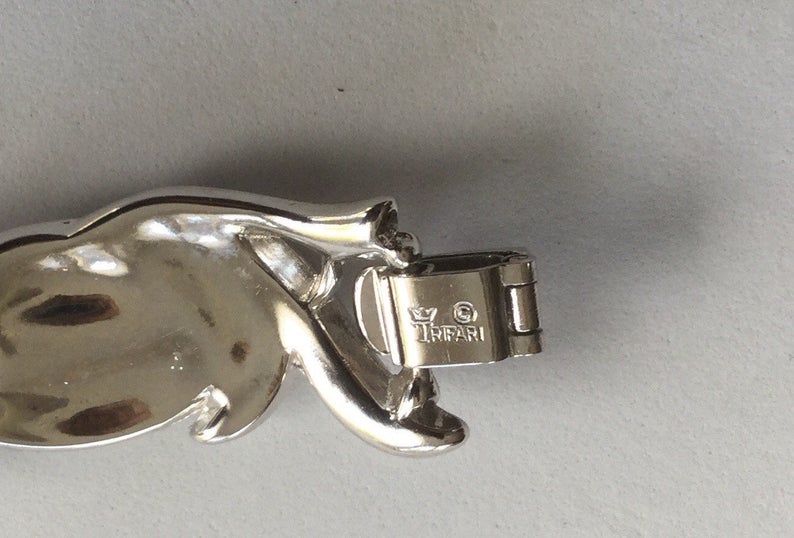
Crown and copyright mark on clasp

Copyright on hook

Crown on tag

Trifari mark in oval

Patent pending mark

Trifari TKF marf

Trifari TKF mark


Resources and Citations
- The Trifari Collection at http://trifaricollection.com/wolf.html
- Trufaux Jewels at https://www.trufauxjewels.com/jewelry-makers-s-z/#trifari