Hansa orange: Difference between revisions
Jump to navigation
Jump to search
No edit summary |
No edit summary |
||
| Line 43: | Line 43: | ||
* Monona Rossol, ''The Artist's Complete Health and Safety Guide'', Allworth Press, New York, 1994 | * Monona Rossol, ''The Artist's Complete Health and Safety Guide'', Allworth Press, New York, 1994 | ||
* Colour Index International online at www.colour-index.org | * Colour Index International online at www.colour-index.org | ||
* CHSOS: [https://chsopensource.org/products/pigments-checker/pigments-checker-modern-and-contemporary-art-pigments-list/po-5-hansa-orange-r/ Spectra (Reflectance, XRF, Raman, FTIR) for PO5 Hansa Orange] | |||
[[Category:Materials database]] | [[Category:Materials database]] | ||
Latest revision as of 09:57, 29 April 2026
Description
Originally a Hoechst AG trademark for a line of bright, transparent orange synthetic organic pigments. Hansa orange dyes are composed of dinitro- or ortho- aniline. This class of dye was first discovered in 1907 by R. Lauch.
See also Hansa.
Synonyms and Related Terms
Pigment Orange 1, 2 and 5; CI Nos. 11725, 12060 and 12075
Listing
| Pigment number (CI) | Pigment names | Manufacture | Comments |
|---|---|---|---|
| PO1 (11725) | unknown | ||
| PO2 (12060) | unknown | ||
| PO5 (12075) | Orthonitroaniline orange; dinitroaniline orange; Permanent Red P-F-7RK; Hansa Red GG |
unknown | impermanent, semi-opaque, mid-value intense orange |
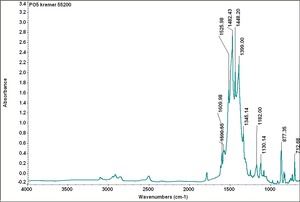
| PO005 | Studio pigment orange | Kremer 55200 | sample contains calcite |
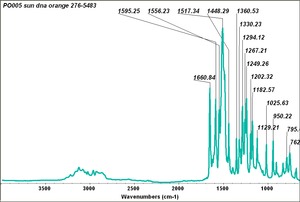
| PO005 | DNA orange | Sun 276-5483 | |
| PO005 | monolite red 2g (beta-napthol) | unknown | from Tate Collection |
Risks
- While listed as non-toxic, CI Pigment Orange 5 is a suspected carcinogen, mutagen and may contain toxic impurities.
Physical and Chemical Properties
- Hue: ranges from bright clean orange to dark reddish orange
- Transparency: transparent to semi-opaque
- Tinting strength: good to excellent tinting strength
- Lightfastness: poor to good lightfastness
- Stability: good chemical (water, acids, bases) and heat resistance
Resources and Citations
- Handprint.com: Orange pigments
- Monona Rossol, The Artist's Complete Health and Safety Guide, Allworth Press, New York, 1994
- Colour Index International online at www.colour-index.org
- CHSOS: Spectra (Reflectance, XRF, Raman, FTIR) for PO5 Hansa Orange