Asphaltum: Difference between revisions
No edit summary |
No edit summary |
||
| Line 4: | Line 4: | ||
1) An old name for [[asphalt|asphalt]] generally used prior to the 1800s. | 1) An old name for [[asphalt|asphalt]] generally used prior to the 1800s. | ||
2) In the 17th and 18th centuries, the term asphaltum also referred to a transparent brown, [[asphalt|asphalt]]-based pigment used in [[watercolor%20paint|watercolor]] and [[oil%20paint|oil paints] for glazes and shadows. The oily material can slow the drying of [[linseed%20oil|linseed oil]] producing a soft film. With time, asphaltum in dried oil films can result in the movement or disfigurement of the film as well as [[ | 2) In the 17th and 18th centuries, the term asphaltum also referred to a transparent brown, [[asphalt|asphalt]]-based pigment used in [[watercolor%20paint|watercolor]] and [[oil%20paint|oil paints] for glazes and shadows. The oily material can slow the drying of [[linseed%20oil|linseed oil]] producing a soft film. With time, asphaltum in dried oil films can result in the movement or disfigurement of the film as well as [[alligator%20crack|alligator cracks]]. Asphaltum was sold commercially as a transparent brown artist pigment under the name bitumen (Gettens and Stout 1966). | ||
== Synonyms and Related Terms == | == Synonyms and Related Terms == | ||
| Line 12: | Line 12: | ||
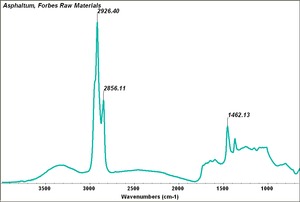
[[[SliderGallery rightalign|Asphaltum, Forbes Raw Materials.TIF~FTIR]]] | [[[SliderGallery rightalign|Asphaltum, Forbes Raw Materials.TIF~FTIR]]] | ||
== | == Risks == | ||
Combustible. Softens at slightly elevated temperatures. | |||
Ages poorly in dried oil films resulting in movement, disfigurement and/or cracks. | |||
== Physical and Chemical Properties == | |||
Soluble in petroleum hydrocarbons, turpentine, and most organic solvents. Partially soluble in oils. | Soluble in petroleum hydrocarbons, turpentine, and most organic solvents. Partially soluble in oils. | ||
Microscopic ID: amorphous, brown particles with conchoidal fracture and/or curved particle boundaries. RI < 1.662. Isotropic in crossed polars. | Microscopic ID: amorphous, brown particles with conchoidal fracture and/or curved particle boundaries. RI < 1.662. Isotropic in crossed polars. | ||
== Additional Images == | == Additional Images == | ||
| Line 34: | Line 33: | ||
== | == Resources and Citations == | ||
* R.White "Brown and Black Organic Glazes, Pigments and Paints" ''National Gallery Technical Bulletin'', 10:58-71, 1986. ° R. J. Gettens, G.L. Stout, Painting Materials, A Short Encyclopaedia, Dover Publications, New York, 1966 | |||
* R. J. Gettens, G.L. Stout, ''Painting Materials, A Short Encyclopaedia'', Dover Publications, New York, 1966 | * R. J. Gettens, G.L. Stout, ''Painting Materials, A Short Encyclopaedia'', Dover Publications, New York, 1966 | ||
Revision as of 15:00, 11 August 2020

Description
1) An old name for asphalt generally used prior to the 1800s.
2) In the 17th and 18th centuries, the term asphaltum also referred to a transparent brown, asphalt-based pigment used in watercolor and [[oil paint|oil paints] for glazes and shadows. The oily material can slow the drying of linseed oil producing a soft film. With time, asphaltum in dried oil films can result in the movement or disfigurement of the film as well as alligator cracks. Asphaltum was sold commercially as a transparent brown artist pigment under the name bitumen (Gettens and Stout 1966).
Synonyms and Related Terms
2) bitumen; Antwerp brown; asphalt paint; Asphalt (Deut.); asfalto (Port.); asphalte (Fr.); asfalto (Esp.); asfaltos (Gr.); alfalto (It.); bitume (It.); asfalt (Ned.); asfalto (Port.)
Risks
Combustible. Softens at slightly elevated temperatures.
Ages poorly in dried oil films resulting in movement, disfigurement and/or cracks.
Physical and Chemical Properties
Soluble in petroleum hydrocarbons, turpentine, and most organic solvents. Partially soluble in oils.
Microscopic ID: amorphous, brown particles with conchoidal fracture and/or curved particle boundaries. RI < 1.662. Isotropic in crossed polars.
Additional Images

Asphaltum, PPL, 200x
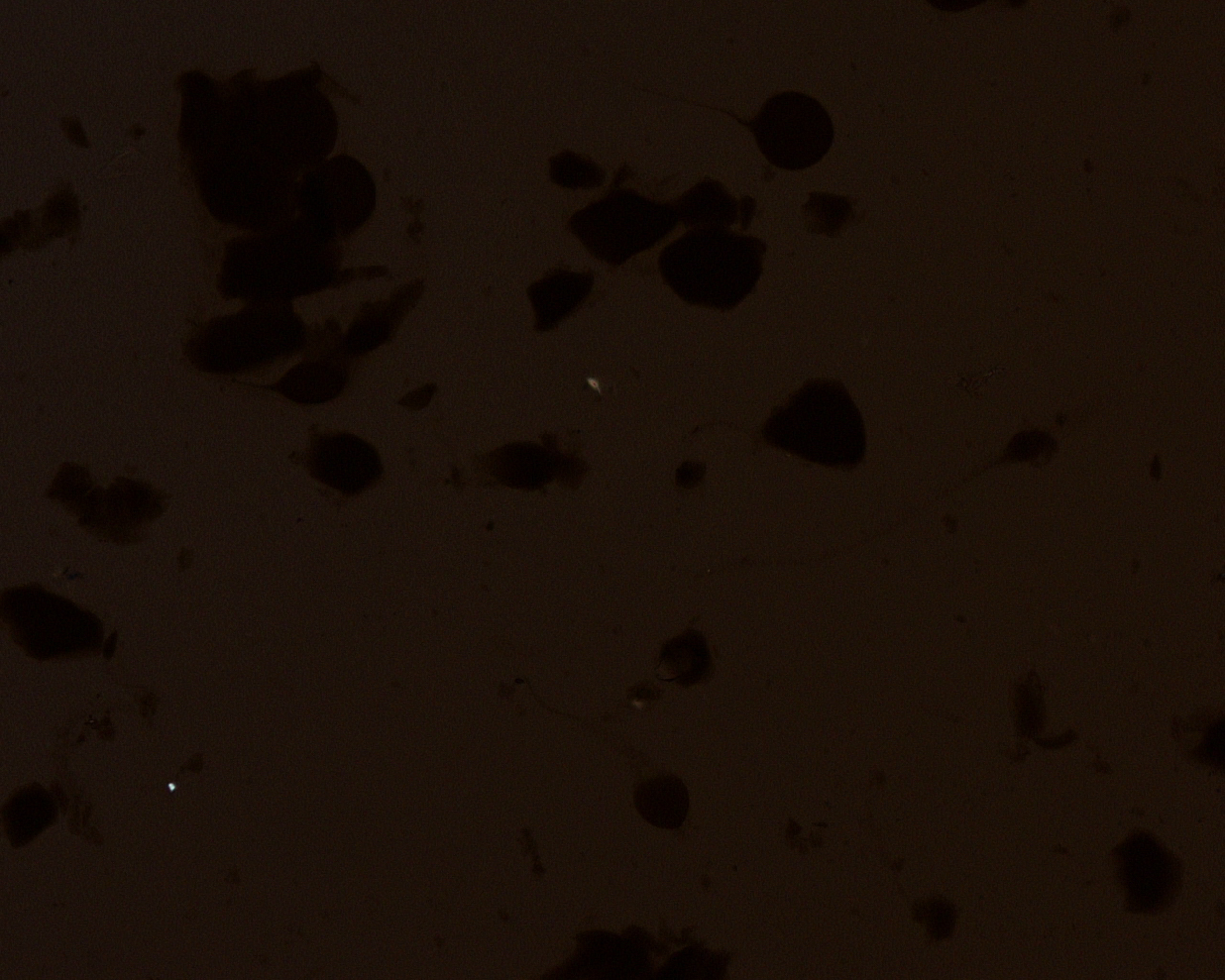
Asphaltum, XPL, 200x


Resources and Citations
- R.White "Brown and Black Organic Glazes, Pigments and Paints" National Gallery Technical Bulletin, 10:58-71, 1986. ° R. J. Gettens, G.L. Stout, Painting Materials, A Short Encyclopaedia, Dover Publications, New York, 1966
- R. J. Gettens, G.L. Stout, Painting Materials, A Short Encyclopaedia, Dover Publications, New York, 1966
- Ralph Mayer, A Dictionary of Art Terms and Techniques, Harper and Row Publishers, New York, 1969 (also 1945 printing)
- Susan E. Schur, Conservation Terminology: A review of Past & Current Nomenclature of Materials, Technology and Conservation, Spring (p.34-39); Summer (p.35-38); Fall (p.25-36), 1985
- R.D. Harley, Artists' Pigments c. 1600-1835, Butterworth Scientific, London, 1982
- Dictionary of Building Preservation, Ward Bucher, ed., John Wiley & Sons, Inc., New York City, 1996
- Thomas B. Brill, Light Its Interaction with Art and Antiquities, Plenum Press, New York City, 1980
- Art and Architecture Thesaurus Online, http://www.getty.edu/research/tools/vocabulary/aat/, J. Paul Getty Trust, Los Angeles, 2000
- Eastaugh, N. et al. The Pigment Compendium, a Dictionary and Optical Microscopy of Historical Pigments, Butterworth-Heinemann, 2008.