Mineral oil: Difference between revisions
No edit summary |
No edit summary |
||
| Line 7: | Line 7: | ||
2) The term 'mineral oil' was originally used as a synonym for | 2) The term 'mineral oil' was originally used as a synonym for | ||
[[petroleum|petroleum]]. | [[petroleum|petroleum]]. | ||
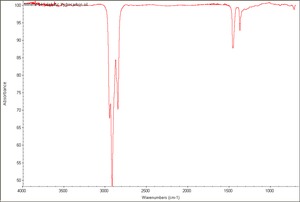
[[[SliderGallery rightalign|Mineral oil, aliphatic hydrocarbon oil.TIF~FTIR(MFA)]]] | |||
== Synonyms and Related Terms == | == Synonyms and Related Terms == | ||
huile minérale (Fr.); aceite mineral (Esp.); olio minerale (It); liquid paraffin; liquid petrolatum; white mineral oil; white Russian oil; Nujol; paraffin oil; vaseline oil; Phoebus | huile minérale (Fr.); aceite mineral (Esp.); olio minerale (It); liquid paraffin; liquid petrolatum; white mineral oil; white Russian oil; Nujol; paraffin oil; vaseline oil; Phoebus | ||
== Risks == | |||
* May be harmful by ingestion or inhalation. | |||
* Skin contact may cause irritation. | |||
* Combustion products are carbon monoxide and carbon dioxide. | |||
* Flammable. Flash point = 135C (275F) | |||
* Flinn Scientific: [https://www.flinnsci.com/sds_529-mineral-oil/sds_529/ SDS] | |||
== Other Properties == | == Other Properties == | ||
| Line 24: | Line 29: | ||
|- | |- | ||
! scope="row"| Density | ! scope="row"| Density | ||
| 0.83-0.91 | | 0.83-0.91 g/ml | ||
|} | |} | ||
== | ==Resources and Citations== | ||
* R. J. Gettens, G.L. Stout, ''Painting Materials, A Short Encyclopaedia'', Dover Publications, New York, 1966 | * R. J. Gettens, G.L. Stout, ''Painting Materials, A Short Encyclopaedia'', Dover Publications, New York, 1966 | ||
| Line 47: | Line 44: | ||
* Hermann Kuhn, ''Conservation and Restoration of Works of Art and Antiquities'', Butterworths, London, 1986 | * Hermann Kuhn, ''Conservation and Restoration of Works of Art and Antiquities'', Butterworths, London, 1986 | ||
* Art and Architecture Thesaurus Online, | * Art and Architecture Thesaurus Online, https://www.getty.edu/research/tools/vocabulary/aat/, J. Paul Getty Trust, Los Angeles, 2000 | ||
[[Category:Materials database]] | [[Category:Materials database]] | ||
Latest revision as of 20:32, 3 August 2022
Description
1) A colorless, aliphatic hydrocarbon oil obtained from petroleum distilled at 330-360C. Mineral oil, or liquid petrolatum, is normally divided into two fractions: light mineral oil (density 0.83-0.88) and heavy mineral oil (density 0.86-0.91). Mineral oil is used as a lubricants for textile processing. It was also used in a much touted formulation ( Phoebus) for the removal of bloom on varnished oil paintings. This practice, however, is not recommended. Mineral oil is chemically inactive and is unlikely to damage aged linseed oil films; however, once it is placed on a painting, the mineral oil will be virtually impossible to completely remove.
2) The term 'mineral oil' was originally used as a synonym for
petroleum.
Synonyms and Related Terms
huile minérale (Fr.); aceite mineral (Esp.); olio minerale (It); liquid paraffin; liquid petrolatum; white mineral oil; white Russian oil; Nujol; paraffin oil; vaseline oil; Phoebus
Risks
- May be harmful by ingestion or inhalation.
- Skin contact may cause irritation.
- Combustion products are carbon monoxide and carbon dioxide.
- Flammable. Flash point = 135C (275F)
- Flinn Scientific: SDS
Other Properties
Soluble in ether, chloroform, carbon disulfide, naphtha, benzene. Insoluble in water, cold ethanol or glycerol.
| CAS | 8012-95-1 |
|---|---|
| Density | 0.83-0.91 g/ml |
Resources and Citations
- R. J. Gettens, G.L. Stout, Painting Materials, A Short Encyclopaedia, Dover Publications, New York, 1966
- M. Doerner, The Materials of the Artist, Harcourt, Brace & Co., 1934
- Ralph Mayer, A Dictionary of Art Terms and Techniques, Harper and Row Publishers, New York, 1969 (also 1945 printing)
- Richard S. Lewis, Hawley's Condensed Chemical Dictionary, Van Nostrand Reinhold, New York, 10th ed., 1993
- Hermann Kuhn, Conservation and Restoration of Works of Art and Antiquities, Butterworths, London, 1986
- Art and Architecture Thesaurus Online, https://www.getty.edu/research/tools/vocabulary/aat/, J. Paul Getty Trust, Los Angeles, 2000