Amur cork tree
Jump to navigation
Jump to search

Description

The bark from the amur cork tree (Phellodendron amurense) is extracted to produce a traditional Japanese natural dye known for for its vivid, brilliant yellow color. Kihada, the Japanese term, has been used for centuries, dating back to the Nara period (710–794), for both textiles and paper. It was valued for its bright hue and anti-microbial properties. The principal colorant component is berberine, a natural alkaloid. No color-fixing mordant is required to achieve the bright yellow; simply boiling the bark for 20 minutes is sufficient.

For use and analysis see:
- Amur cork tree (Phellodendrom amurense Rupr. Rutaceae) LC
- Kihada (Amur cork tree) - right (281 R)
- Kihada + Ai - left (281 L)
Synonyms and Related Terms
Phellodendron amurense; kihada (Jap.); Japanese yellow wood
Physical and Chemical Properties
- Colorant is water-soluble and fixes without a mordant
- Lightfastness is poor
- Autofluorescence = intense yellow
- When but, the bark smells like citrus
Additional Images

Kihada
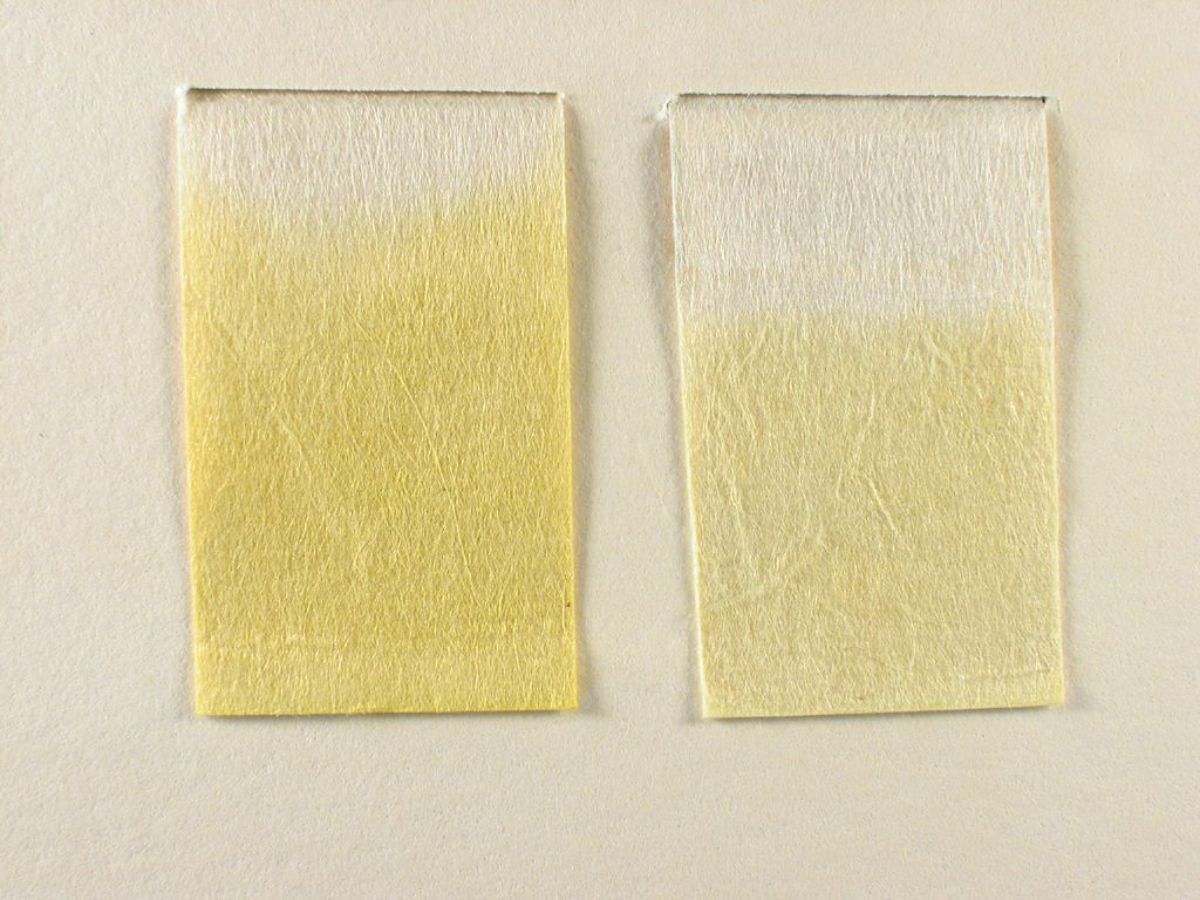
Kihada


Resources and Citations
- S.Simoyama, Y.Noda, S.Katshuhara, "Non-Destructive Analysis of Ukiyo-E Prints" Dyes in History and Archaeology, No.15, Paper presented in Manchester England, Nov. 1996.
- Encyclopedia Britannica, http://www.britannica.com Comment: cork tree" a [Accessed March 5, 2002].
- R.Feller, M.Curran, C.Bailie, 'Identification of Traditional Organic Colorants Employed in Japanese Prints and Determination of their Rates of Fading', Japanese Woodblock Prints, Allen Memorial Art Museum, Oberlin College, Oberlin, 1984