Safflower

Description

A thistle plant, Carthamus tinctorius, native to Egypt, northern India, and the Near East. Safflower was widely cultivated throughout Asia and Europe by the end of the thirteenth century for use of the petals as a dye colorant as well as the oil in its seeds. The tender annual with spiny leaves and composite orange flower heads contains both a yellow dye and a red dye. The yellow colorant, safflor, is water soluble and light unstable so it is rarely used. The red dye, carthamin, is extracted from the dried, crushed flower heads with a weak alkali solution after the yellow has been removed with cold water. The red safflower dye was commonly used for dyeing red or pink silk and linen since ancient times. Safflower red was used to dye government red tape and may have been used as a pigment. Carthamin is not a permanent color and is sensitive to acids, alkalis, heat, and light.
- For dye colors: [Uemera Dye Archive] Benibana
- For analysis info: [Dye Analysis] Safflower
- For woodblock printing: [Safflower: Ukiyo-e colorant]


Synonyms and Related Terms
Carthamus tinctorius; Natural Yellow 5; Natural Red 26; carthame (Fr.); faux safran (Fr.); Deutscher saflor (Deut.); cartamo (It., Esp.); saffloor (Ned.); beni (Jap.); benibana (Jap.); Färberdistel (Deut.); knikos (Gr.); karthamos (Gr.); saffloor (Ned.); cartamina (Port.); carthamus; bastard saffron; carthamin; distaff thistle; dyer's thistle; seaflower; African saffron; false saffron; safflor; rose carthame; saffron thistle; American saffron
Physical and Chemical Properties
- Safflor is soluble in water and is not lightfast.
- Carthamin is soluble in alkalis, but only slightly soluble in water.
- Carthamin fluoresces brightly in UV light. It is also sensitive to hear, light and acid.
- ISO R105 Lightfastness Classification = 1
- CAS = 1401-20-3
Additional Images

Beni (safflower) dyed reference for Japanese prints

Beni dyed silk in normal light Uemera Dye Archive
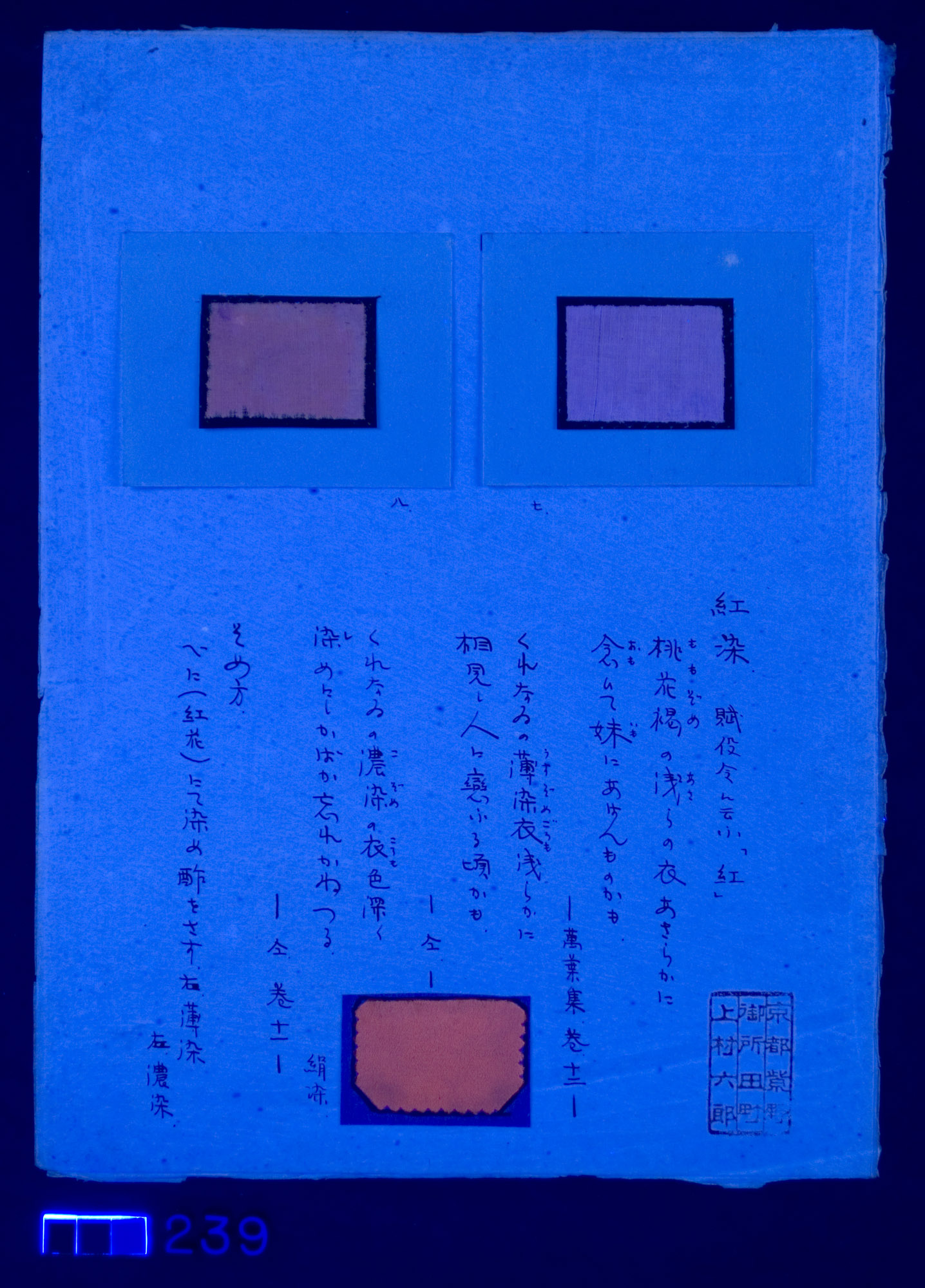
Beni dyed silk in UV light
Uemera Dye Archive


Colorant Extraction
The safflower florets are picked, dried and then soaked in cold water at least an hour to remove the non-lightfast yellow dye (safflor) and leave the red colorant (carthamin). The yellow liquid is removed, then the same petals are placed in a warm, weak alkaline bath containing about 10% of the petal’s weight in soda ash (sodium carbonate) to dissolve the red pigment. Soak about 2 hours until the solution is a deep reddish-orange then neutralize the bath with vinegar or citric acid (pH 6) to produce a deep red color. The deepest reds are obtained with numerous initial cold-water washings to remove all of the water-soluble yellows. The petals will turn from orange-red to a dull tan color when the yellow dye is fully removed. Safflower red dye is not very stable and cannot tolerate high heat or high pH levels.
Resources and Citations
- J.Hofenk-de Graaf, Natural Dyestuffs: Origin, Chemical Constitution, Identification, Central Research Laboratory for Objects of Art and Science, Amsterdam, September 1969.
- Analytical strategies for natural dyestuffs in cultural heritage objects - EU-ARTECH European research project - http://www.organic-colorants.org
- R.J. Adrosko, Natural Dyes in the United States, Smithsonian Institution Press, Washington, DC, 1968
- Helmut Schweppe, Schweppe color collection index and information book
- Palmy Weigle, Ancient Dyes for Modern Weavers, Watson-Guptill Publications, New York, 1974
- John and Margaret Cannon, Dye Plants and Dyeing, Herbert Press, London, 1994
- Encyclopedia Britannica, http://www.britannica.com Comment: "safflower." (Accessed 5 Dec. 2004).
- R.Feller, M.Curran, C.Bailie, 'Identification of Traditional Organic Colorants Employed in Japanese Prints and Determination of their Rates of Fading', Japanese Woodblock Prints, Allen Memorial Art Museum, Oberlin College, Oberlin, 1984
- F. Crace-Calvert, Dyeing and Calico Printing, Palmer & Howe, London, 1876
- Colour Index International online at www.colour-index.org
- J. Thornton, 'The Use of Dyes and Colored Varnishes in Wood Polychromy', Painted Wood: History and Conservation, Getty Conservation Insitute, Los Angeles, 1998
- R. J. Gettens, G.L. Stout, Painting Materials, A Short Encyclopaedia, Dover Publications, New York, 1966
- G.S.Brady, Materials Handbook, McGraw-Hill Book Co., New York, 1971 Comment: p. 826
- Ralph Mayer, A Dictionary of Art Terms and Techniques, Harper and Row Publishers, New York, 1969 (also 1945 printing)
- R.D. Harley, Artists' Pigments c. 1600-1835, Butterworth Scientific, London, 1982
- The Merck Index, Martha Windholz (ed.), Merck Research Labs, Rahway NJ, 10th edition, 1983 Comment: entry 1918 - carthamus
- The American Heritage Dictionary or Encarta, via Microsoft Bookshelf 98, Microsoft Corp., 1998
- Thomas B. Brill, Light Its Interaction with Art and Antiquities, Plenum Press, New York City, 1980
- Art and Architecture Thesaurus Online, http://www.getty.edu/research/tools/vocabulary/aat/, J. Paul Getty Trust, Los Angeles, 2000