Rhodamine B

Description

A strong, bright red fluorescent dye. Rhodamine B is a basic dye that was developed in 1887 by Ceresole. It is used as textile and paper dye, as a pigment, and as a staining reagent for the detection of fats and oils. Some oil modified materials such as alkyds and urethanes will also stain with rhodamine (Wolbers et al 1990). Rhodamine B has been used as a fluorescent colorant in inks (ballpoint, printing), wood stains, distemper paints, colored glass, plastics, and shoe polish.

Synonyms and Related Terms
Basic Violet 10; CI 45170; tetraethylrhodamine; D&C Red No. 19, Solvent Red 49; Pigment Violet 1 (phosphotungstomolybdic acid salt); Pigment Red 173 (aluminum salt); Rhodamine (Deut.); Rodamina B (Esp.); rodamina B (Port.); rhodamine B (Fr.)
Comparisons
Rhodamine B variations with some properties and descriptions
| Other names | Laked form | Comments |
|---|---|---|
| Rhodamine 610; Basic Violet 10 | identification by fluorescence microscopy and laser dyes; used as pH indicator and water tracer | |
| D&C Red #19 | formerly used in drugs and cosmetics but was removed from list in 1984 as a suspected carcinogen | |
| Solvent red 49 | fluorescent red dye used in wood stains and coating, printing inks and leather finishes. | |
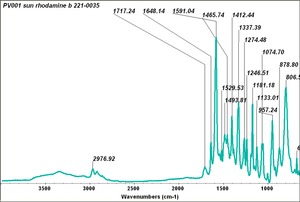
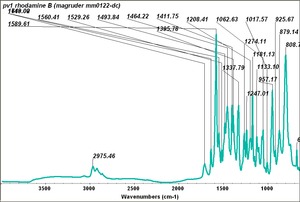
| Pigment Violet 1 | phosphotungstomolybdic acid salt | introduced in 1924; bright reddish-violet with high color strength and good lightfastness; used in printing inks, textile printing, and, in some cases, plastics due to its high gloss and vivid shade |
| Pigment Red 173; Rhodamine Red; Cosmetic Rubine | aluminum salt | brilliant pink to magenta used in inks, powder coatings, industrial paints, colored glass and plastics; Extensively used in cosmetic products |



Risks
- Listed as carcinogen and mutagen.
- Harmful if swallowed
- Can cause eye damage and allergic reactions in skin
- Store in glass containers as it is absorbed by plastics
- ThermoFisher: SDS
Physical and Chemical Properties
- Soluble in water, alcohols, and polar solvents.
- Decomposes in chlorinated solutions.
- Maximum absorption wavelength = 545 nm.
- Maximum emission wavelength = 625 nm.
- Composition = C28H31ClN2O3 (mol. wt. = 478.68 g/mol)
- CAS = 81-88-9
- Melting Point = 210-211 C
Resources and Citations
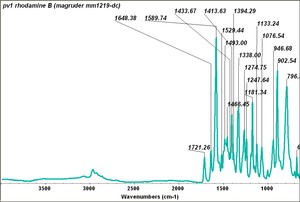
- A. Schaening, M. Schreiner, D. Jembrih-Simbuerger, 'Identification and Classification of Synthetic Organic Pigments of a Collection of the 19th and 20th century by FTIR' The Sixth Infrared and Raman Users Group Conference (IRUG6), Florence Italy, 2004.
- R. Wolbers, N. Sterman and C. Stavroudis, "Notes for Workshop on New Methods in the Cleaning of Paintings", 1990, GCI, Los Angeles.
- Website for absorption/fluorescent spectra: http://www.omlc.ogi.edu/spectra/PhotochemCAD/html/rhodamineB.html
- Reed Kay, The Painter's Guide To Studio Methods and Materials, Prentice-Hall, Inc., Englewood Cliffs, NJ, 1983
- Richard S. Lewis, Hawley's Condensed Chemical Dictionary, Van Nostrand Reinhold, New York, 10th ed., 1993
- Monona Rossol, The Artist's Complete Health and Safety Guide, Allworth Press, New York, 1994
- The Merck Index, Martha Windholz (ed.), Merck Research Labs, Rahway NJ, 10th edition, 1983 Comment: entry 8349
- Dye History: www.straw.com/sig/dyehist - discovered 1887
- Aldrich Chemical Catalog Comment: p. 1299
- Colour Index International online at www.colour-index.org
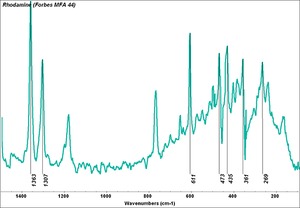
- CHSOS: Spectra (XRF, Raman, Reflectance) on PR 173
- Wikipedia: Rhodamine B Accessed Dec. 2025