Turmeric

Description

A natural yellow or brown dye obtained from the root the Curcuma domestica (or C. longa) plant native to India and southeast Asia where it was used as a flavoring and colorant (textiles and skin). It was also known in Mesopotamia and used by the ancient Greeks and Romans. When imported to Europe is 1612, turmeric became a popular yellow dye for silk scarves. In 17th and 18th c. Japan, turmeric was the most commonly used yellow colorant for woodblock prints.
When sold as a powder, turmeric was prepared by drying either the grated roots, or the hot water extract. The primary color component in turmeric is curcumin. It is a water-soluble dye that forms a bright yellow color on cotton without a mordant. Darker orange to brown shades are produced with alum, tin, chromium, and copper mordants. Iron mordants produce a dull green shade. The fugitive colorant was also used to make yellow pigments and to tint varnishes. Turmeric is currently used as a flavoring agent in curry powder and as a yellow colorant in mustard, cheese, paper, wood, and wax.

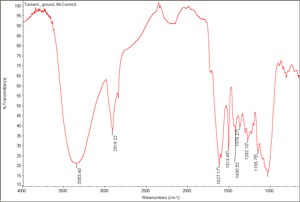
- For analysis info: [Dye Analysis] Turmeric
- For woodblock printing: [Turmeric: Ukiyo-e colorant]
Synonyms and Related Terms
tumeric (sp, AAT); Curcuma domestica; Curcuma longa; Natural Yellow 3; CI 75300; curcumin; safran des Indes (Fr.); Gelbwurz (Deut.); terra merita (It.); cúrcuma (Esp.); curcuma (Ned., Port.); merita earth; camotilla; haide; halad; Indian saffron; safran d'Inde; souchet; ukon (Jap.); tumerick; turmerech; terre merite; yellow ginger; yellow root; yo-kin

Risks
- The colorant is sensitive to light and will fade.
- ThermoFisher: SDS
Physical and Chemical Properties
- Curcumin is soluble in water, ethanol and ether.
- Turmeric is yellow in neutral and acidic solutions but will turn brownish-red in alkaline solutions.
- Turmeric is fluorescent in UV light*
- ISO R105 Lightfastness Classification = 1
- Composition = C21H20O6
- CAS = 458-37-7
- Melting Point = 183 C
- Molecular Weight = mol. wt. = 368.39
Additional Images

Ground turmeric
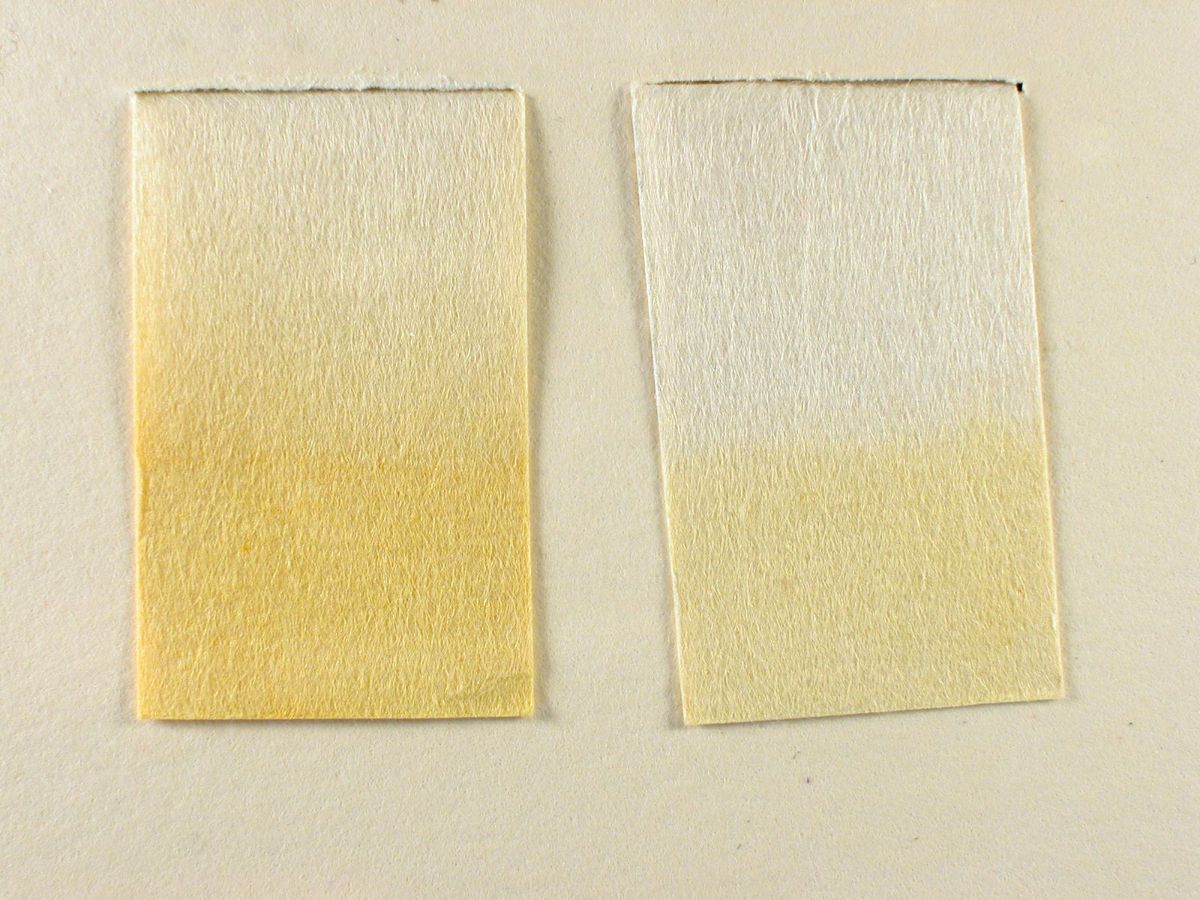
Turmeric
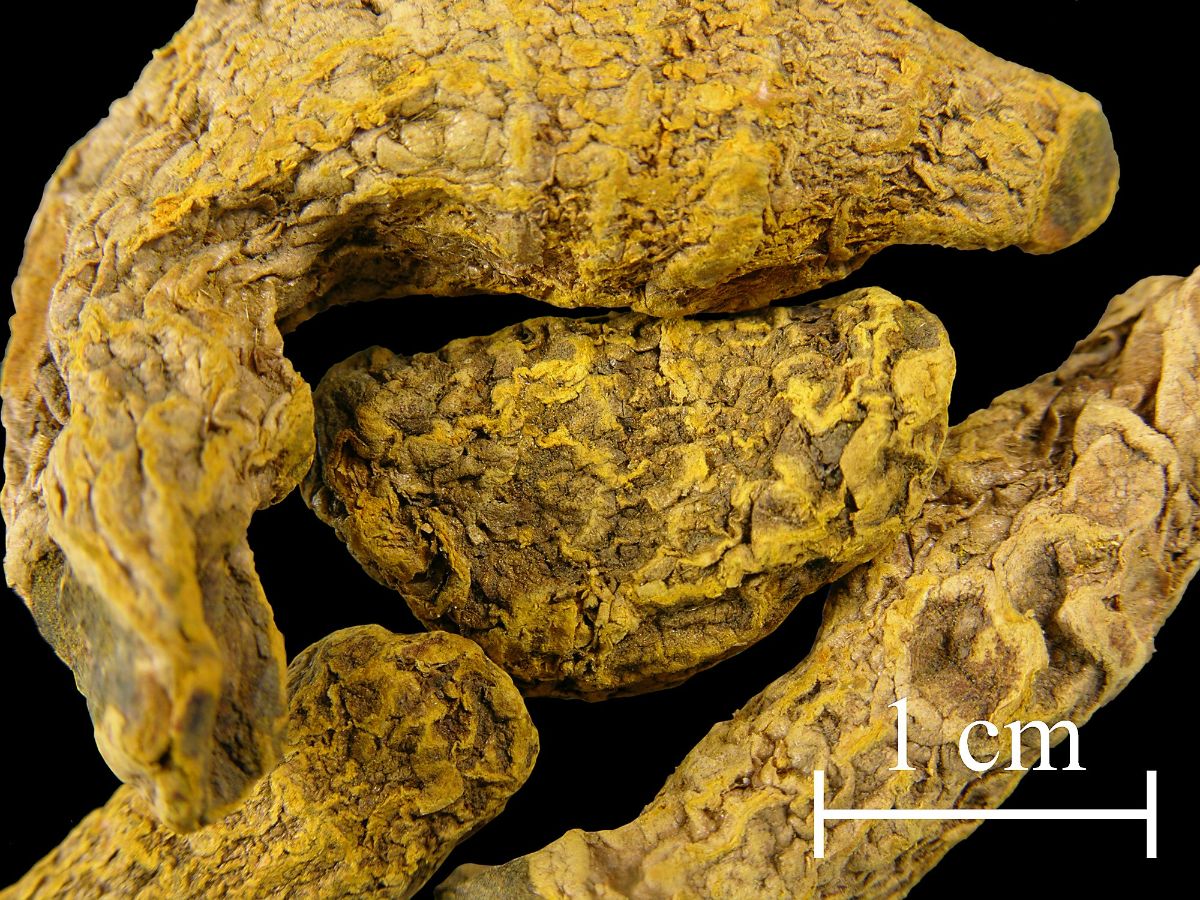
Ukon


Colorant Extraction
Turmeric rhizome was grated or ground into a powder to increase its surface area then placed in a pot of water and brought to a simmer or boil. The mixture was heated for an hour or more, then filtered through a fine mesh cloth to separate the liquid dye from the solid turmeric particles. The remaining concentrated yellow liquid was the dye bath whose color can be changed by modifying the pH. A bright, light yellow is formed by adding acidic lime juice, while adding alkaline lime powder to the dye bath produces a darker, orange-yellow shade. The liquid can be evaporated to produce a thicker, curcumin-enriched paste or "gummy mess".
Resources and Citations
- Palmy Weigle, Ancient Dyes for Modern Weavers, Watson-Guptill Publications, New York, 1974 Comment: Gives plant name as Curcuma longa
- R.D. Harley, Artists' Pigments c. 1600-1835, Butterworth Scientific, London, 1982
- Matt Roberts, Don Etherington, Bookbinding and the Conservation of Books: a Dictionary of Descriptive Terminology, U.S. Government Printing Office, Washington DC, 1982 Comment: Gives plant name as Curcuma longa
- John and Margaret Cannon, Dye Plants and Dyeing, Herbert Press, London, 1994
- R.Feller, M.Curran, C.Bailie, 'Identification of Traditional Organic Colorants Employed in Japanese Prints and Determination of their Rates of Fading', Japanese Woodblock Prints, Allen Memorial Art Museum, Oberlin College, Oberlin, 1984
- F. Crace-Calvert, Dyeing and Calico Printing, Palmer & Howe, London, 1876 Comment: Gives plant name as Curcuma longa
- J. Thornton, 'The Use of Dyes and Colored Varnishes in Wood Polychromy', Painted Wood: History and Conservation, The Getty Conservation Insitute, Los Angeles, 1998 Comment: lists Curcuma domestica as currently accepted name; C.longa as former; also C.tinctoria, C.verdiflora as additional names
- Sigma Dyes, Stains and Natural Pigments, Infrared Library, Nicolet, 1991-1995 Comment: OMNIC: formula= C21H20O6, CAS= 458-37-7, plant name as C.longa
- Helmut Schweppe, Schweppe color collection index and information book
- The Merck Index, Martha Windholz (ed.), Merck Research Labs, Rahway NJ, 10th edition, 1983 Comment: entry 9955
- The American Heritage Dictionary or Encarta, via Microsoft Bookshelf 98, Microsoft Corp., 1998
- Colour Index International online at www.colour-index.org Comment: CAS= 458-37-7
- G.S.Brady, Materials Handbook, McGraw-Hill Book Co., New York, 1971 Comment: p. 360
- Ralph Mayer, A Dictionary of Art Terms and Techniques, Harper and Row Publishers, New York, 1969 (also 1945 printing) Comment: Gives plant name as Curcuma longa
- Book and Paper Group, Paper Conservation Catalog, AIC, 1984, 1989
- "Violin Varnish Glossary" at www.violins.on.ca/luthier.vargloss.html - gives plant name as Curcuma longa
- Tom Rowland, Noel Riley, A-Z Guide to Cleaning, Conserving and Repairing Antiques, Constable and Co., Ltd., London, 1981
- Art and Architecture Thesaurus Online, http://www.getty.edu/research/tools/vocabulary/aat/, J. Paul Getty Trust, Los Angeles, 2000
- Wikipedia: Turmeric
- CHSOS: Spectra (Reflectance, XRF, Raman, FTIR) for Curcuma