Hansa yellow: Difference between revisions
No edit summary |
|||
| (9 intermediate revisions by the same user not shown) | |||
| Line 3: | Line 3: | ||
[[File:Hansayellow C100x.jpg|thumb|Hansa yellow at 100x (visible light left; UV light right)]] | [[File:Hansayellow C100x.jpg|thumb|Hansa yellow at 100x (visible light left; UV light right)]] | ||
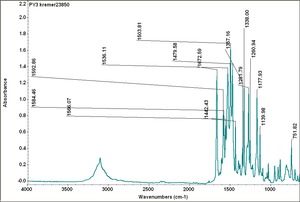
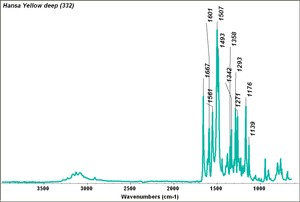
[[[SliderGallery rightalign|PY3 kremer23850.TIF~FTIR PY3(MFA)|Hansa Yellow 332.TIF~FTIR Forbes 332(MFA)|Hansa Yellow (Forbes MFA 331) collodion slide, 785 nm (640x445).jpg~Raman|f331sem.jpg~SEM|f331edsbw.jpg~EDS|Slide1 FC331.PNG~XRF]]] | [[[SliderGallery rightalign|PY3 kremer23850.TIF~FTIR PY3(MFA)|Hansa Yellow 332.TIF~FTIR Forbes 332(MFA)|Hansa Yellow (Forbes MFA 331) collodion slide, 785 nm (640x445).jpg~Raman|f331sem.jpg~SEM|f331edsbw.jpg~EDS|Slide1 FC331.PNG~XRF]]] | ||
Originally a brand name [Hoechst AG] for a series of bright yellow synthetic organic pigments. Hansa yellow is now a commonly used designation for this class of yellow [[arylide|monoazo]] colorants. They are also called arylamide yellows. Developed in Germany in the early 20th century, Hansa yellow was the first permanent organic yellow pigment. It was available for artists paints about 1915. The insoluble colorants have good lightfastness and weather resistance but are susceptible to bleeding in some media and discoloration when heated. They were commonly used as inexpensive substitutes for [[Cadmium yellow|cadmium yellows]] in paints, plastics, rubber, printing inks and paper coatings. Recently, they have been superseded by [[Diarylide | Originally a brand name [Hoechst AG] for a series of bright yellow synthetic organic pigments. Hansa yellow is now a commonly used designation for this class of yellow [[arylide|monoazo]] colorants. They are also called arylide and arylamide yellows. Developed in Germany in the early 20th century, Hansa yellow was the first permanent organic yellow pigment. It was available for artists paints about 1915. The insoluble colorants have good lightfastness and weather resistance but are susceptible to bleeding in some media and discoloration when heated. They were commonly used as inexpensive substitutes for [[Cadmium yellow|cadmium yellows]] in paints, plastics, rubber, printing inks and paper coatings. Recently, they have been superseded by [[Diarylide dyes|diarylide]] and [[vat yellow|vat yellows]]. | ||
A number preceding the G indicates the degree of toning, i.e., 10G is greener than 5G. | A number preceding the G indicates the degree of toning, i.e., 10G is greener than 5G. | ||
* Hansa R is a reddish yellow. | * Hansa Yellow R is a reddish yellow. | ||
* Hansa G is a greenish-yellow. | * Hansa Yellow G is a greenish-yellow. | ||
== Synonyms and Related Terms == | == Synonyms and Related Terms == | ||
| Line 13: | Line 14: | ||
== Listing == | == Listing == | ||
Many monoazo yellow are used as artists' pigments and marked under the names 'Hansa' or Arylide. Some are listed below, for more see [https://www.artiscreation.com/yellow.html#ci_pigment_yellow The Color of Art Pigment Database] | |||
{| class="wikitable" | {| class="wikitable" | ||
! Pigment number (CI) !! Pigment names !! Comments | ! Pigment number (CI) !! Pigment names !! Comments | ||
|- | |- | ||
| PY1 () || | | PY1 (11680) || Hansa Yellow; Hansa Yellow G/10G|| Introduced as artist pigment 1911; bright light to medium yellow, some have a greenish tone; good lightfastness | ||
|- | |||
| PY2 (11730) || Hansa Yellow GR|| bright yellow | |||
|- | |- | ||
| PY3 ( | | PY3 (11710) || Hansa Yellow light; Lemon yellow|| Bright lemon-like yellow with some green undertone; currently sold by Kremer (23850) as studio yellow; darkens with age shifting to brown | ||
|- | |- | ||
| | | PY6 (11670) || Hansa Yellow 3G; Hansa Golden Yellow|| sometimes called a bold or bright yellow | ||
|- | |- | ||
| PY97 () || Hansa | | PY10 (12710) || Hansa Yellow R|| a pyrazolone azo with a reddish yellow tone | ||
|- | |||
| PY74 (11741) || Hansa Yellow medium; Hansa Brilliant Yellow 5GX || Mid-range yellow ranging to greenish yellow; good primary yellow for artist but has poor lightfastness | |||
|- | |||
| PY97 (11767) || Hansa Yellow deep; Hansa Yellow FGL|| Mid-shade yellow ranging to warmer, more reddish yellow; can fade | |||
|} | |} | ||
==Physical and Chemical Properties== | ==Physical and Chemical Properties== | ||
* Hue: ranges from cool, greenish yellows to warmer, slightly reddish-yellow | * Hue: ranges from cool, greenish yellows to warmer, slightly reddish-yellow | ||
* Transparency: | * Transparency: transparent to semi-transparent | ||
* Tinting strength: | * Tinting strength: good to very good | ||
* Lightfastness: Good to very good | * Lightfastness: Good to very good | ||
* Toxicity: Listed as non-toxic | * Toxicity: Listed as non-toxic | ||
* Stability: resistant to oil, water, acids and bases; not bleed resistant; only heat stable to 150C | |||
==Resources and Citations== | ==Resources and Citations== | ||
| Line 44: | Line 52: | ||
* Richard S. Lewis, ''Hawley's Condensed Chemical Dictionary'', Van Nostrand Reinhold, New York, 10th ed., 1993 | * Richard S. Lewis, ''Hawley's Condensed Chemical Dictionary'', Van Nostrand Reinhold, New York, 10th ed., 1993 | ||
* Art and Architecture Thesaurus Online, https://www.getty.edu/research/tools/vocabulary/aat/, J. Paul Getty Trust, Los Angeles, 2000 | * Art and Architecture Thesaurus Online, https://www.getty.edu/research/tools/vocabulary/aat/, J. Paul Getty Trust, Los Angeles, 2000 | ||
* Wikipedia: [https://en.wikipedia.org/wiki/Arylide_yellow Arylide yellow] Accessed March 2026 | |||
* CHSOS: [https://chsopensource.org/products/pigments-checker/pigments-checker-modern-and-contemporary-art-pigments-list/py-3-hansa-yellow-10g/ Spectra (Reflectance, XRF, Raman, FTIR) for PY3 Hansa Yellow] | |||
[[Category:Materials database]] | [[Category:Materials database]] | ||
Latest revision as of 10:21, 29 April 2026

Description

_collodion_slide,_785_nm_(640x445).jpg)


Originally a brand name [Hoechst AG] for a series of bright yellow synthetic organic pigments. Hansa yellow is now a commonly used designation for this class of yellow monoazo colorants. They are also called arylide and arylamide yellows. Developed in Germany in the early 20th century, Hansa yellow was the first permanent organic yellow pigment. It was available for artists paints about 1915. The insoluble colorants have good lightfastness and weather resistance but are susceptible to bleeding in some media and discoloration when heated. They were commonly used as inexpensive substitutes for cadmium yellows in paints, plastics, rubber, printing inks and paper coatings. Recently, they have been superseded by diarylide and vat yellows.
A number preceding the G indicates the degree of toning, i.e., 10G is greener than 5G.
- Hansa Yellow R is a reddish yellow.
- Hansa Yellow G is a greenish-yellow.
Synonyms and Related Terms
arylide yellow; arylamide; monoazo yellow; Monolite yellow; Talens' yellow; Pigment Yellow 1, 3, 5 and 10; Hansagelb (Deut.); jaune solide (Fr.)
Listing
Many monoazo yellow are used as artists' pigments and marked under the names 'Hansa' or Arylide. Some are listed below, for more see The Color of Art Pigment Database
| Pigment number (CI) | Pigment names | Comments |
|---|---|---|
| PY1 (11680) | Hansa Yellow; Hansa Yellow G/10G | Introduced as artist pigment 1911; bright light to medium yellow, some have a greenish tone; good lightfastness |
| PY2 (11730) | Hansa Yellow GR | bright yellow |
| PY3 (11710) | Hansa Yellow light; Lemon yellow | Bright lemon-like yellow with some green undertone; currently sold by Kremer (23850) as studio yellow; darkens with age shifting to brown |
| PY6 (11670) | Hansa Yellow 3G; Hansa Golden Yellow | sometimes called a bold or bright yellow |
| PY10 (12710) | Hansa Yellow R | a pyrazolone azo with a reddish yellow tone |
| PY74 (11741) | Hansa Yellow medium; Hansa Brilliant Yellow 5GX | Mid-range yellow ranging to greenish yellow; good primary yellow for artist but has poor lightfastness |
| PY97 (11767) | Hansa Yellow deep; Hansa Yellow FGL | Mid-shade yellow ranging to warmer, more reddish yellow; can fade |
Physical and Chemical Properties
- Hue: ranges from cool, greenish yellows to warmer, slightly reddish-yellow
- Transparency: transparent to semi-transparent
- Tinting strength: good to very good
- Lightfastness: Good to very good
- Toxicity: Listed as non-toxic
- Stability: resistant to oil, water, acids and bases; not bleed resistant; only heat stable to 150C
Resources and Citations
- R. J. Gettens, G.L. Stout, Painting Materials, A Short Encyclopaedia, Dover Publications, New York, 1966
- Reed Kay, The Painter's Guide To Studio Methods and Materials, Prentice-Hall, Inc., Englewood Cliffs, NJ, 1983 Comment: available as an artist color since the 1930s
- Ralph Mayer, A Dictionary of Art Terms and Techniques, Harper and Row Publishers, New York, 1969 (also 1945 printing)
- Hermann Kuhn, Conservation and Restoration of Works of Art and Antiquities, Butterworths, London, 1986 Comment: Developed in Germany in 1900; first used as an artist color about 1910
- B. Berrie, S.Q. Lomax, 'Azo Pigments: Their History, Synthesis, Properties and Use in Artists' Materials', Studies in the History of Art , National Gallery of Art, Washington DC, No. 57, 1997 Comment: First sold in 1909; used as an artist color in 1915
- M. de Keijzer, 'A survey of red and yellow modern synthetic organic artists pigments discovered in the 20th century and used in oil colors', ICOM Preprints Lyons, France, Getty Conservation Institute, Los Angeles, p. 369, 1999
- Thomas Gregory, The Condensed Chemical Dictionary, Reinhold Publishing, New York, 3rd ed., 1942
- Richard S. Lewis, Hawley's Condensed Chemical Dictionary, Van Nostrand Reinhold, New York, 10th ed., 1993
- Art and Architecture Thesaurus Online, https://www.getty.edu/research/tools/vocabulary/aat/, J. Paul Getty Trust, Los Angeles, 2000
- Wikipedia: Arylide yellow Accessed March 2026
- CHSOS: Spectra (Reflectance, XRF, Raman, FTIR) for PY3 Hansa Yellow